

MBBR Full Form — What Is MBBR in STP?
MBBR full form is Moving Bed Biofilm Reactor. In sewage treatment, MBBR is a biological wastewater treatment process that uses free-floating plastic bio-carriers in an aerated reactor tank. Bacteria grow as a biofilm on these carriers, breaking down organic matter (BOD/COD) in the sewage. MBBR sewage treatment plants are compact, handle variable loads efficiently, and consistently produce CPCB-compliant effluent with BOD below 20 mg/L — making them the most widely installed STP technology in India for residential, commercial, and industrial applications.
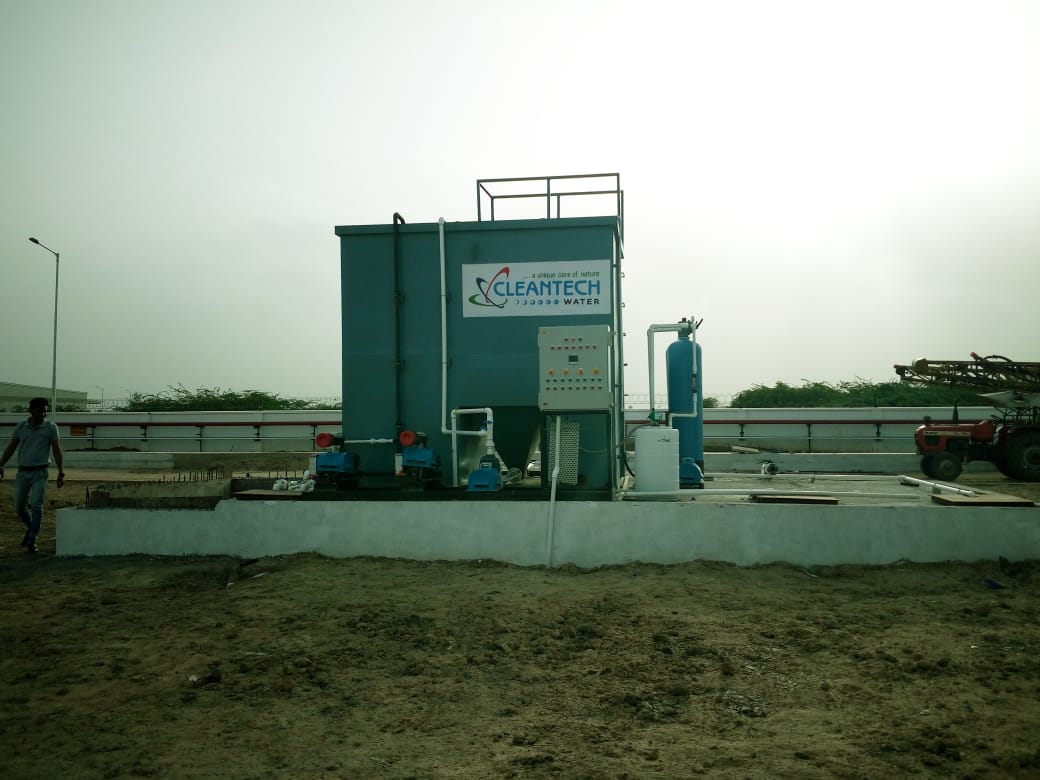 Cleantech Water has been manufacturing MBBR sewage treatment plants in Ahmedabad since 2013 — and in that time, MBBR has become our most installed STP technology, across housing societies in Gandhinagar, hotel properties in Surat, industrial facilities in Rajkot, and hospitals in Vadodara. The reason is consistent: when you need a plant that performs reliably under variable daily loads, fits in a limited footprint, and can be installed in weeks rather than months, MBBR delivers without the complexity of MBR or the automation dependency of SBR.
150+
STP Installations
13+
Years Manufacturing
10–3000
KLD Capacity Range
BOD <20
mg/L Effluent Quality
How Does an MBBR Sewage Treatment Plant Work?
The MBBR process is built around one core principle: instead of keeping bacteria suspended in the mixed liquor (as conventional activated sludge does) or growing them on fixed media (as trickling filters do), MBBR grows them on free-floating plastic carriers. Each carrier — typically a polyethylene cylinder 10–25mm in diameter with internal cross-channels — has a protected surface area of 300–900 m²/m³. Bacteria colonise the internal channels, where they are shielded from the turbulence of the aeration system while remaining in continuous contact with the wastewater flowing past.
The carriers are kept in suspension by the aeration blower — the same air that supplies oxygen for aerobic bacteria also agitates the carrier bed, preventing them from settling. A retention screen at the reactor outlet keeps carriers inside the tank while allowing treated water to pass through to the secondary clarifier. This means the biomass concentration in an MBBR reactor is largely decoupled from the hydraulic retention time — you can run more biology in a smaller volume than a conventional activated sludge system allows.
MBBR Process Stages — Step by Step
| Stage | What Happens | Pollutants Removed |
|---|---|---|
| 1. Inlet Screening | Coarse screen (6–12 mm) removes rags, solids, and fibrous material before feed enters reactor | Gross solids that would foul the carrier media |
| 2. Equalization | Flow equalization tank buffers peak-load surges — hotels and housing societies produce 3–4x average flow at morning and evening peaks | Smooths hydraulic load variation; prevents reactor upset |
| 3. MBBR Reactor (Aerobic) | Plastic bio-carriers (40–60% fill ratio) float in aerated basin; aerobic bacteria on carriers consume BOD/COD. DO maintained at 2–4 mg/L | BOD 85–95% removal, COD 70–85% removal, partial nitrification |
| 4. Secondary Clarifier | Gravity settling of suspended solids from reactor effluent; clarified water overflows to disinfection | TSS reduced to <30 mg/L |
| 5. Sludge Recirculation / Wasting | Settled sludge partially returned to reactor for seeding; excess wasted to sludge holding tank for periodic removal | Maintains MLSS balance; controls sludge age |
| 6. Disinfection (UV/Chlorination) | UV lamps or chlorine dosing at final effluent — kills remaining pathogens before discharge or reuse | Total Coliform <1000 MPN/100 mL (CPCB discharge), <200 for reuse |
Why bio-carrier fill ratio matters
MBBR reactors are typically designed with 40–60% carrier fill ratio by volume. Going above 70% causes carriers to jam and reduces effective mixing. Going below 30% underutilises the available biofilm surface area and increases reactor volume needed. Cleantech Water designs to 50% fill ratio as standard — a conservative number that leaves headroom for peak loading without risking carrier jamming or channeling.
MBBR vs SBR vs MBR — Complete Comparison for Indian Projects
This question comes up in almost every STP procurement conversation. The honest answer is that each technology has a specific fit — and the wrong choice creates either an over-engineered plant that costs more than needed, or an under-specified one that fails compliance tests. Here is how the three technologies compare on the factors that actually matter for Indian residential and industrial projects:
| Parameter | MBBR ✓ (This Page) | SBR | MBR |
|---|---|---|---|
| Effluent BOD | 10–20 mg/L | 10–20 mg/L | <5 mg/L |
| CPCB Compliance | ✅ Consistently | ✅ Consistently | ✅ Exceeds norms |
| Footprint | Compact | Very Compact | Smallest |
| Capital Cost/KLD | ₹40,000–₹80,000 | ₹55,000–₹95,000 | ₹80,000–₹1,50,000 |
| Variable Load Handling | Excellent — biofilm is resilient | Excellent — batch process adapts | Good |
| Power Consumption | 0.5–0.8 kWh/KLD | 0.6–0.9 kWh/KLD | 1.0–1.5 kWh/KLD |
| Operator Skill Required | Low — simple operation | Low–Medium (PLC automated) | Medium–High (membrane care) |
| Maintenance Cost | Lowest | Low | Highest (membrane replacement) |
| Water Reuse Suitability | Irrigation, flushing (with UV) | Irrigation, flushing (with UV) | Cooling towers, direct reuse |
| Best For | Most Indian residential, hotel, and industrial projects | Automation priority, space-critical, hospitals | Water reuse targets, pharma, luxury properties |
Cleantech Water manufactures all three technologies. Our recommendation is always based on your site constraints and goals — not on which product has the higher margin. For most housing societies and commercial buildings in India, MBBR delivers the best combination of compliance, simplicity, and long-term operating cost.
MBBR Sewage Treatment Plant Cost in India — 2026 Price Guide
MBBR is the most cost-effective biological STP technology per unit of treated water for capacities between 10 KLD and 500 KLD — which covers the majority of residential, commercial, and medium industrial projects in India. Here are realistic 2026 prices for Cleantech Water’s packaged MBBR systems, fully installed:
| MBBR STP Capacity | Suitable For | Approx. Installed Cost | Monthly O&M |
|---|---|---|---|
| 10–20 KLD | 50–100 flat society, small hotel | ₹6–₹14 lakh | ₹8,000–₹18,000 |
| 25–50 KLD | 150–300 flat gated community, 80-room hotel | ₹14–₹32 lakh | ₹15,000–₹30,000 |
| 100 KLD | 500+ flat township, 200-room hotel, mid-size industry | ₹40–₹65 lakh | ₹35,000–₹55,000 |
| 200–500 KLD | Large industrial campus, township, institutional | ₹80 lakh–₹2.5 crore | ₹60,000–₹1,50,000 |
*Prices are for packaged FRP/MS MBBR systems — turnkey (civil, mechanical, electrical, commissioning). Excludes 18% GST. Prices vary by site conditions and inlet water quality. Contact us for site-specific quotation.
For a detailed breakdown of residential STP costs, see our residential sewage treatment plant cost guide covering apartment society and housing colony pricing in detail.
Cleantech Water MBBR STP — Features and Specifications
Our MBBR sewage treatment plants are manufactured at our Ahmedabad facility and factory-tested before dispatch. Every unit is designed for Indian operating conditions — variable inlet quality, daily load fluctuations, and the need for dual manual/automatic operation that doesn’t require a trained process engineer on-site.
Technical Specifications
| Capacity Range | 10 KLD to 3,000 KLD (packaged FRP/MS up to 500 KLD; civil structure for larger) |
| Bio-carrier Type | HDPE polyethylene carriers, 300–500 m²/m³ specific surface area, 40–50% fill ratio |
| BOD Removal | 85–95% removal; outlet BOD <20 mg/L (CPCB Class A: <30 mg/L) |
| COD Removal | 70–85% removal; outlet COD <100 mg/L (CPCB limit: <250 mg/L) |
| TSS Outlet | <30 mg/L (CPCB limit: <100 mg/L) |
| Operating Mode | Dual — manual and automatic (toggle via control panel) |
| Installation Mode | Above-ground (packaged skid) or underground (RCC pit with packaged internals) |
| Construction (Vessel) | MS with epoxy coating (standard) / FRP / SS 304 (on request) |
| Aeration System | Fine bubble diffuser + centrifugal blower; dual screen retention for bio-carriers |
| Installation Timeline | 2–4 weeks (packaged units up to 100 KLD); 4–8 weeks for larger civil-integrated systems |
Industries and Applications — Where Cleantech Water Has Installed MBBR STPs
MBBR’s combination of compact footprint, low maintenance, and reliable performance under variable loads makes it the technology of choice across a broad range of Indian property and industry types. Cleantech Water has installed MBBR-based STPs across these sectors:
🏢 Residential Societies
Housing societies, apartments, gated communities — RERA & NGT compliance, OC documentation support
🏨 Hotels & Resorts
Variable occupancy loads handled by biofilm resilience — kitchen grease trap integration available
🏥 Hospitals & Clinics
Pathogen-reduction performance; MoEFCC compliance documentation for PCB consent
🍼 Food Processing & Dairy
High-BOD food effluent with grease trap pre-treatment; FSSAI-compliant treated water
🧵 Textile Industry
Domestic sewage from textile campuses — separate from dye effluent which requires ETP
🏗️ Real Estate & IT Parks
Developer-stage STP integration — GIFT City, Ahmedabad township projects commissioned
⚙️ Industrial Campuses
Canteen, sanitary sewage from oil & gas, pharma, fertilizer, auto, steel facilities
🎓 Schools & Institutions
Hostels, college campuses — compact underground units where space is at a premium
Get a Free Site Assessment for Your MBBR STP
Cleantech Water — MBBR sewage treatment plant manufacturer in Ahmedabad, Gujarat. Free capacity sizing + technology recommendation. Pan-India supply and installation.
Frequently Asked Questions — MBBR Sewage Treatment Plant
What is MBBR full form in STP?
MBBR full form in STP is Moving Bed Biofilm Reactor. It refers to a biological sewage treatment process where bacteria grow as biofilm on free-floating plastic carriers (bio-media) inside an aerated reactor tank. MBBR full form in water treatment is the same — Moving Bed Biofilm Reactor — used for both sewage (domestic wastewater) and effluent (industrial wastewater) treatment applications.
What is MBBR technology in STP and how is it different from conventional systems?
MBBR technology in STP uses plastic bio-carriers with high specific surface area (300–500 m²/m³) to grow attached-growth bacteria, instead of the suspended-growth bacteria used in conventional activated sludge systems. Key differences: MBBR doesn’t require a sludge return system (the biofilm stays on the carriers), handles variable loads without performance drop, requires less reactor volume for the same BOD removal, and produces more stable effluent during low-flow periods when conventional systems struggle with sludge settling.
Is MBBR better than SBR for housing societies in India?
For most Indian housing societies, MBBR and SBR are both good choices — the decision depends on specific site constraints. MBBR is preferred when daily load variation is high (occupancy-driven communities), when the building management team has limited technical staff, and when installation timeline is tight. SBR is preferred when space is extremely limited and PLC automation is acceptable. Both technologies produce CPCB-compliant effluent. MBBR typically has lower capital cost at smaller capacities (below 50 KLD).
What is the capacity range of MBBR sewage treatment plants?
Cleantech Water’s MBBR sewage treatment plants are available from 10 KLD to 3,000 KLD. Packaged FRP/MS units are practical up to 500 KLD for site logistics reasons — above that, civil (RCC) construction with packaged MBBR internals is the standard approach. The 10–100 KLD range covers most housing societies, hotels, hospitals, and commercial buildings. Industrial campuses and townships typically fall in the 100–500 KLD range.
Can an MBBR plant be installed underground?
Yes — underground MBBR STP installation is available and is Cleantech Water’s preferred option for housing societies and hotels where aesthetics and odour control are priorities. The packaged MBBR unit is installed in an RCC pit with only the access hatches and blower room visible at ground level. Underground installation adds ₹15,000–₹25,000/KLD to the cost versus above-ground placement, but eliminates visual impact and simplifies blower noise management.
What O&M support does Cleantech Water provide after MBBR installation?
Cleantech Water offers Annual Maintenance Contracts (AMC) and Operation & Maintenance (O&M) contracts for all installed MBBR plants. AMC coverage includes monthly scheduled visits, DO and effluent quality monitoring, blower maintenance, carrier inspection, minor consumable replacement, and CPCB compliance documentation support. Emergency call-out response is included. Monthly AMC charges for a 25 KLD MBBR plant run approximately ₹15,000–₹25,000 depending on contract scope.
Cleantech Water is a wastewater treatment plant manufacturer in Ahmedabad with 13+ years and 150+ installations across India. For MBBR sewage treatment plant enquiries — capacity sizing, site assessment, or AMC for an existing plant — contact us at +91-9558996411 or Info@cleantechwater.co.in. We serve all of Gujarat plus Maharashtra, Rajasthan, Madhya Pradesh, Telangana, and Chhattisgarh.
Vipul Chavda — Co-Founder, Cleantech Water
With 13+ years designing and commissioning MBBR, SBR, and MBR sewage treatment plants across Gujarat and 6 Indian states, Vipul leads Cleantech Water’s engineering team. Clients include GIFT City, Adani, TATA, Mother Dairy, L&T, and Arvind Group across 150+ installations.