

Modern industries and residential complexes in India face strict environmental regulations. The Central Pollution Control Board (CPCB) mandates harsh limits on wastewater discharge. Meeting these norms requires more than just basic settling tanks or biological aeration. You need advanced tertiary filtration to polish the final effluent. This is where activated carbon water treatment becomes an absolute necessity for any serious facility.
Wastewater often looks clean after secondary treatment, but still hides microscopic threats. Dissolved toxins, lingering smells, and stubborn chemicals remain in the water. Plant managers must decide on the best filtration media to remove these invisible pollutants. Two main options dominate the market. You can choose Granular Activated Carbon (GAC) or Powdered Activated Carbon (PAC). Both materials rely on the incredible science of adsorption, but they operate in completely different ways. Choosing the wrong type can lead to significant operational costs, frequent breakdowns, and regulatory fines.
This comprehensive guide will break down everything you need to know about GAC and PAC. We will compare their costs, explore their industrial applications, and help you decide which activated carbon water treatment strategy is best for your specific Effluent Treatment Plant (ETP) or Sewage Treatment Plant (STP).
Why Activated Carbon Matters in ETP and STP Systems
While primary and secondary treatments successfully handle solids and organic waste, the water leaving the clarifier is rarely fit for discharge or reuse. It demands a highly effective final polishing stage. An activated carbon filter serves this purpose. Packed with microscopic pores, the carbon acts like a molecular sponge. Through adsorption, it permanently traps hidden pollutants on its vast internal surface.
Industrial facilities and residential STPs rely on this process to eliminate stubborn contaminants that survive biological treatment. Activated carbon water treatment excels at removing complex dyes, turning dark industrial effluent completely clear. It also strips away volatile organic compounds, immediately eliminating foul odours. Activated carbon also neutralizes surplus chlorine. This provides a vital layer of protection for delicate Reverse Osmosis (RO) membranes located further down the filtration line.
Finally, carbon filtration reliably catches lingering traces of Chemical Oxygen Demand (COD), dissolved organics, and dangerous micropollutants like trace solvents. Since these threats easily slip through standard sand filters, carbon must capture them. This ensures your facility consistently meets strict CPCB norms, producing high-quality treated water safe for cooling towers, gardening, or toilet flushing.
What Is Granular Activated Carbon (GAC)?
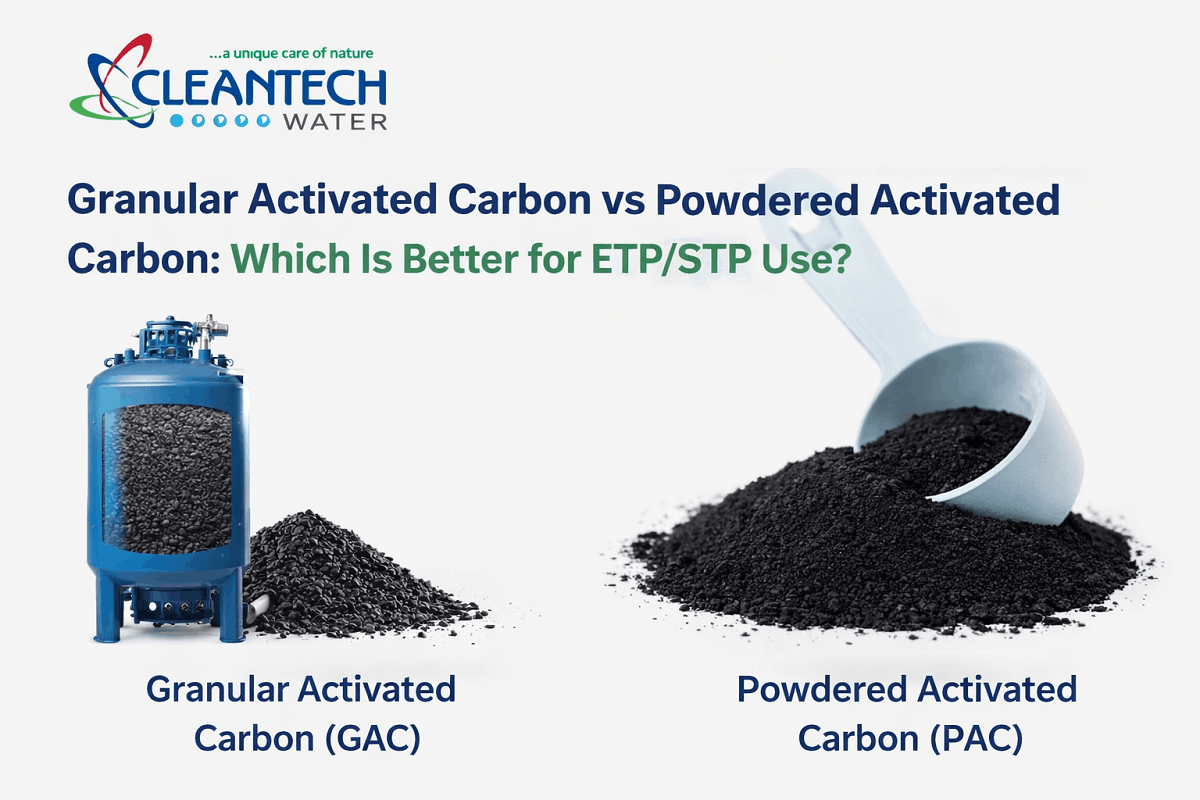
Granular Activated Carbon, commonly known as GAC, is the most widely recognised form of carbon media used in commercial water purification. To the naked eye, GAC looks like coarse black sand or small pieces of crushed gravel. Because of its larger physical size, plant operators do not dissolve it or dump it freely into the water.
Instead, GAC serves as a dedicated bed filtration media. Engineers pack thousands of kilograms of these carbon granules into large, vertical steel or FRP (Fibre Reinforced Plastic) vessels. These are known as fixed-bed filter vessels.
During the activated carbon water treatment process, wastewater is pumped into the top of the vessel. The water slowly trickles downward through the dense bed of carbon granules. As the water passes through the media bed, the contaminants bind to the carbon pores. Clean, polished water flows out from the bottom of the tank. This setup is designed for long-term continuous use, treating thousands of litres of water hour after hour without stopping.
Key Characteristics of GAC
- Optimal Particle Size: Granules typically range from 0.2 mm to 5 mm in diameter.
- Energy-Saving Hydraulics: The physical space between these larger granules allows water to pass through smoothly with a lower pressure drop. This heavily reduces the strain on your feed pumps, saving significant electricity.
- Routine Reusability: You do not have to discard the media the moment it gets dirty. You can simply backwash the filter to easily flush out trapped surface dirt.
- Thermal Regeneration: Once the microscopic pores are entirely filled with pollutants and the carbon is “exhausted,” specialized facilities can heat the media in a furnace. This burns off the trapped toxins and restores the carbon for reuse.
- 24/7 Reliability: Because it can be washed and regenerated, GAC offers an exceptionally long service life, making it the perfect continuous-flow solution for plants operating around the clock.
Common GAC Applications in ETP/STP
- Municipal and Residential STPs: Acts as the reliable, permanent backbone for final water polishing in large-scale housing complexes and city treatment plants.
- Zero Liquid Discharge (ZLD) Systems: Provides critical pre-filtration to clean industrial wastewater before it reaches and potentially damages sensitive RO membranes.
- Tertiary Factory Reuse: Purifies treated effluent to a high standard, allowing industries to safely recycle the water back into their daily manufacturing processes.
- Airborne Odour Control: Utilizes dry carbon beds within dedicated chambers to strip foul-smelling gases from the air before releasing it safely into the environment.
What Is Powdered Activated Carbon (PAC)?
Powdered Activated Carbon (PAC) operates on the same scientific principle of adsorption, but its physical form changes how you use it completely. Unlike the coarse gravel of GAC, PAC is milled down into a very fine carbon powder. It looks and feels like dark black flour.
Because it is so fine, you cannot place PAC inside a standard pressure vessel. The powder would instantly pack together, block the water flow, and create a massive pressure drop that would break your pumps. Instead, PAC requires a direct dosing approach.
Operators use chemical dosing pumps or manual labour to dump the fine powder directly into the open treatment tanks, such as the aeration tank or the clarifier. The powder mixes freely with the wastewater. This makes PAC perfect for batch treatment or temporary shock-load applications. You add it when you need it, let it absorb the toxins, and then allow it to settle out with the rest of the sludge.
Key Characteristics of PAC
- Microscopic Particle Size: The powder is exceptionally fine, with particles measuring well below 0.18 mm.
- Massive External Surface Area: Because it is crushed so deeply, the carbon makes immediate, direct contact with waterborne pollutants.
- Lightning-Fast Adsorption: Unlike GAC beds that require time for water to trickle through, PAC attacks and absorbs toxins almost instantly upon mixing.
- Strictly Single-Use: Once it absorbs the contaminants, it permanently settles into the biological sludge. You cannot separate it out, meaning it must be thrown away alongside your regular solid waste.
- Mandatory Downstream Separation: You absolutely need a robust clarifier or membrane system to catch the fine black dust. If this final separation step fails, the escaped powder will completely ruin your final water quality.
Common PAC Applications in ETP/STP
- Emergency Toxic Spill Rescue: Kept on standby to instantly absorb accidental chemical spills in the equalization tank before the poison can wipe out the sensitive bacteria in the aeration process.
- Managing Shock COD Loads: Provides a rapid, stabilizing dose when sudden factory production changes dump a massive, unexpected load of organic waste into the system.
- Rapid Odour Control: Deployed immediately into the tanks to neutralize sudden, severe smell complaints or gas buildups.
- Seasonal Capacity Overloads: Acts as a temporary booster for facilities dealing with predictable load variations, such as a food processing plant overwhelmed by wastewater during peak harvest season.
Granular Activated Carbon vs Powdered Activated Carbon: Key Differences
Understanding the physical and operational differences between these two media types is crucial for optimising your activated carbon water treatment strategy.
Below is a direct comparison of the most critical parameters you must evaluate before upgrading your facility.
| Parameter | GAC |
PAC |
| Particle size | Larger granules | Fine powder |
| Installation | Fixed filter bed | Direct dosing |
| Adsorption speed | Moderate | Fast |
| Best use | Continuous treatment | Short-term correction |
| Reusability | Yes | Usually no |
| Dust handling | Minimal | High |
| Maintenance | Media replacement cycles | Frequent dosing |
| Lifecycle cost | Lower long-term | Higher recurring |
Which Is Better for ETP Use?
Industrial Effluent Treatment Plants face severe, highly variable challenges. An ETP at a pharma plant deals with entirely different chemicals than an ETP at a sugar mill. The choice between GAC and PAC depends entirely on how often your water quality fluctuates and what your ultimate reuse goals are.
Choose GAC for Continuous Industrial Effluent Treatment
If your factory operates around the clock and produces a steady, predictable volume of wastewater, GAC is the undisputed champion. Facilities that need to recycle water back into their boilers or cooling towers must have a reliable, non-stop filtration system.
GAC is the standard choice for the pharma, textile, chemical, and food processing industries. A textile mill, for example, produces millions of litres of coloured water daily. They cannot manually dose powder into that much water. They need huge steel vessels filled with GAC to run continuously. GAC provides excellent, steady organic contaminant removal without requiring a worker to monitor a powder dosing pump 24/7. When you need guaranteed, continuous activated carbon water treatment, you build a GAC filter.
Choose PAC for Sudden Contamination Spikes
Industrial manufacturing is rarely perfect. Spills happen. Production lines get flushed. When an abnormal event occurs, your ETP bacteria can die from the shock, and your effluent quality will crash. This is where PAC saves the day.
You should keep PAC in your warehouse for sudden colour increase events. If a chemical reactor leaks a dark dye into the drain, tossing PAC into the holding tank will absorb the colour before it violates your discharge permit. It is the best tool for managing COD shock loads. If the organic load suddenly doubles, PAC provides the instant adsorption power needed to bring the numbers down. It is also perfect for temporary odour events and emergency compliance management. When the pollution inspector is scheduled to visit tomorrow, and your water looks slightly off, a heavy dose of PAC will clarify the effluent quickly.
Cost Comparison: GAC vs PAC for Wastewater Plants
Budget approvals often dictate engineering choices. Plant managers must look beyond the price tag on a bag of carbon and evaluate the Total Cost of Ownership (TCO) over a five to ten year period.
Initial Installation Cost
If you look strictly at capital expenditure (Capex) on day one, PAC has a dramatically lower upfront cost. To start using PAC, you only need to buy a few bags of the powder and perhaps a small, inexpensive chemical dosing pump. You utilise your existing clarifier tanks to settle out the powder.
GAC requires a major initial investment. You must design, purchase, and install large pressure vessels. You need specialised piping, pressure gauges, automatic valves, and feed pumps strong enough to push water through the dense media bed. You also have to buy tonnes of granular carbon upfront to fill those giant vessels.
Long-Term Operating Cost
The financial picture flips entirely when you look at operating expenses (Opex) over several years.
PAC has a devastatingly high recurring dosing cost. Because you throw the powder away with the sludge every single day, you must constantly buy new bags of PAC. Furthermore, the added volume of carbon dust increases your total sludge weight. You will have to pay waste management contractors more money to haul away the extra sludge.
GAC offers a far better lifecycle ROI. Once the vessels are filled, the media runs for months or even years, depending on the organic load. You only pay for the minor electricity used by the feed pump and the water used for daily backwashing. More importantly, GAC offers a massive regeneration advantage. When the granules are finally exhausted, you do not send them to a landfill. You send them to a regeneration facility that cleans them for a fraction of the cost of buying virgin carbon. Over a five-year span, a GAC system is drastically cheaper to run than a PAC dosing system.
Expert Recommendation: Which One Should You Choose?
Making the final decision requires a clear understanding of your daily reality.
For permanent ETP/STP systems that run continuously and need to meet strict daily discharge norms, GAC is the undisputed winner. It is cleaner, requires less daily labour, and costs significantly less to operate over the long term.
For temporary corrective treatment, seasonal emergencies, or facilities that simply do not have the physical space to build new steel filter vessels, PAC is your best emergency tool.
When auditing your plant, evaluate these core decision factors.
Core Decision Factors for Plant Audits
When auditing your plant, evaluate these core decision factors:
- What is your daily flow rate? High volumes demand GAC.
- What is your pollutant load? Extreme, sudden spikes demand PAC.
- Do you have available space for pressure vessels? If not, you must use PAC.
- Do you have a dedicated maintenance team to handle messy powder daily? (Open consideration for your internal labor capacity)
- What is your capital budget versus your operating budget? (Open consideration for your financial review)
- What is your reuse objective? If you want crystal clear water for an RO plant, you absolutely need the reliable polishing power of a granular activated carbon filter.
How Cleantech Water Helps You Select the Right Activated Carbon Solution
Upgrading your wastewater treatment plant is a major engineering decision. Guessing the right media size or dosing rate will lead to failed inspections and wasted money. You need a trusted partner who understands the complex chemistry of industrial effluent.
At Cleantech Water, we specialise in end-to-end activated carbon water treatment solutions. We do not just sell carbon bags. Our engineering team conducts a thorough site assessment of your facility. We perform detailed laboratory contaminant analysis on your specific effluent to determine exactly what toxins are slipping through your current system.
Based on hard data, we provide precise carbon media selection, ensuring you get the exact pore size and iodine value required to trap your unique pollutants. We offer complete STP/ETP design consultation, building custom pressure vessels that fit your space and flow requirements. Once your system is running, we provide comprehensive AMC and replacement support, managing your media changeouts and regeneration cycles so you can focus entirely on your core production. Contact Cleantech Water at +91-9099915539 or +91-9558996411 or write to us at info@cleantechwater.co.in to future-proof your wastewater compliance.