

What is an industrial water softener plant?
An industrial water softener plant removes calcium and magnesium ions from hard water through ion exchange — replacing them with sodium ions using a cation resin bed. The result is softened water with hardness below 5 mg/L, suitable for boiler feed, RO pre-treatment, cooling towers, and process water in textile, food, pharma, and chemical industries. Without softening, hard water causes scale formation that reduces boiler efficiency, shortens RO membrane life, and disrupts industrial processes.
Gujarat has a hard water problem that most industries operating here already know about — they just may not have connected the dots between that white scale on the pipes and the rising maintenance bills on their boiler or cooling tower. Half the blocks in Ahmedabad and Surat report groundwater hardness above 400 mg/L, well into the “very hard” classification. Inland districts towards Saurashtra push even higher, with some borewells registering 600–800 mg/L. For context, BIS 10500 recommends a desirable limit of 200 mg/L and an acceptable maximum of 600 mg/L for drinking water — industrial equipment is far less tolerant.
At Cleantech Water, we install water softener systems as stand-alone units and as pre-treatment for industrial RO plants and boiler feed water systems across Gujarat. The decision to soften — and whether softening alone is enough or needs to be combined with demineralisation or RO — is one of the more common technical questions we field from plant engineers and purchase managers. This guide covers that decision clearly.
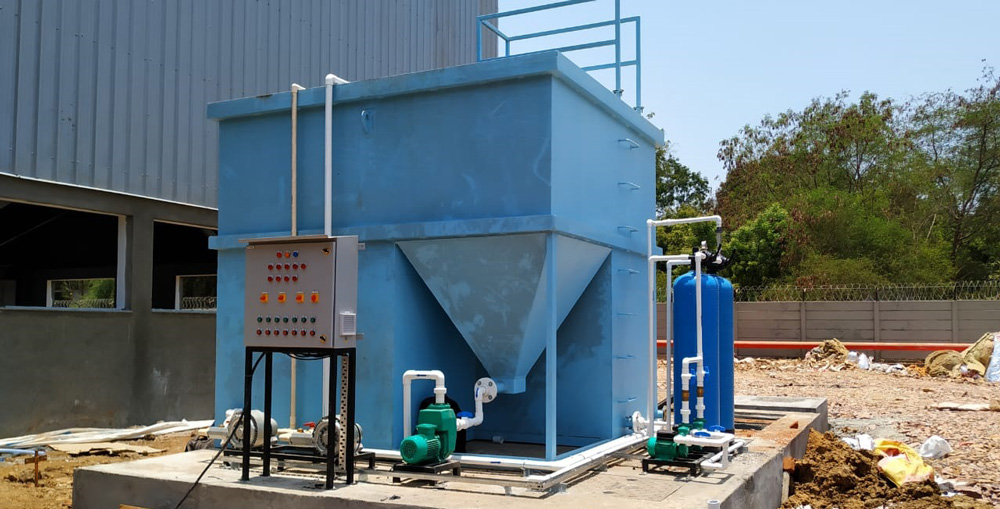
Industrial water treatment installation — Cleantech Water, Ahmedabad
What Is Hard Water and Why Does It Damage Industrial Equipment?
Hard water contains elevated concentrations of dissolved calcium (Ca²⁺) and magnesium (Mg²⁺) ions — minerals picked up as groundwater percolates through limestone and chalk deposits. In most of Gujarat, Rajasthan, and inland Maharashtra, these concentrations are high enough to cause serious operational problems in any system that heats, pressurises, or concentrates water.
The physics of the problem is straightforward: calcium and magnesium carbonates have inverse solubility — they become less soluble as temperature rises. At boiler operating temperatures, they precipitate as calcium carbonate scale on heating surfaces. A 1mm scale layer reduces heat transfer efficiency by approximately 10%; a 3mm layer by around 25%. The boiler burns more fuel to achieve the same steam output, and the tube metal behind the scale overheats — eventually causing hot spots, tube wall thinning, and in severe cases, rupture. The Indian Boiler Regulations (IBR) exist partly because these failures are dangerous, not just expensive.
The same chemistry plays out in cooling towers (where evaporation concentrates minerals), RO membranes (where calcium carbonate scaling is the leading cause of irreversible flux decline), textile dyeing machines (where calcium deposits cause uneven dye uptake), and food processing equipment (where it affects cleaning effectiveness and product quality). The difference between industries is not whether hard water causes problems — it always does — but how quickly and at what hardness threshold the damage becomes measurable.
How Hard Is “Too Hard” — Industry-Specific Limits
| Industrial Application | Maximum Acceptable Hardness | Standard / Source |
|---|---|---|
| High-pressure boiler feed water | <1 mg/L (near zero) | Indian Boiler Regulations (IBR) |
| Low-pressure boiler feed water | <5 mg/L | IBR / IS 3751 |
| RO membrane feed water | <50 mg/L (without antiscalant) | Membrane manufacturer specs |
| Cooling tower makeup water | <85 mg/L | BIS / Cycles of concentration management |
| Textile dyeing process water | <50 mg/L | Industry practice (dye quality) |
| Food & beverage process water | <100 mg/L | FSSAI / BIS 10500 |
| Pharmaceutical process water | <5 mg/L (purified water) | IP / USP Pharmacopoeia |
| General industrial washing/cleaning | <150–200 mg/L | BIS 10500 acceptable limit |
Gujarat’s groundwater hardness (200–800 mg/L depending on location) exceeds the acceptable limit for every application in this table except general cleaning. For any industry drawing on borewells in Ahmedabad, Rajkot, Bhavnagar, Junagadh, or inland Saurashtra, some form of hardness treatment is not optional — it is a maintenance cost versus a capital cost decision.
How Does an Ion Exchange Water Softener Work?
Ion exchange water softening is the standard technology for industrial hardness removal — it has been reliable, well-understood, and cost-effective for over 60 years. The process involves three components: a pressure vessel containing cation exchange resin (typically sulfonated polystyrene beads in sodium form), a brine (salt) regeneration system, and a multiport control valve.
Feed water passes through the resin bed under pressure. The resin preferentially binds calcium and magnesium ions, releasing an equivalent number of sodium ions into the water. The exchange continues until the resin is exhausted — which happens when all the resin’s sodium sites have been replaced by calcium and magnesium. At this point, the resin must be regenerated: a concentrated sodium chloride (brine) solution is passed through the resin bed, which reverses the exchange, displacing calcium and magnesium back into the brine and re-loading the resin with sodium. The spent brine is flushed out, and the system returns to service.
Types of Industrial Water Softeners Available in India
Three configurations are available, each suited to different operational contexts:
Manual softeners require an operator to initiate regeneration based on water usage or a time schedule. They are the lowest-cost option (₹60,000–₹3 lakh depending on capacity) and are appropriate for small industries with consistent low-flow usage and reliable operators. The risk is delayed regeneration — if the operator misses the regeneration cycle, hardness passes through to the process.
Semi-automatic softeners use a timer or volume meter to signal when regeneration is required, but an operator manually initiates the brine flow. They reduce oversight burden while remaining lower-cost than fully automatic systems. Appropriate for most medium-scale industrial applications (₹1.5–₹8 lakh range).
Fully automatic softeners use a multiport automatic valve (time-clock or demand-initiated) to run through the full regeneration sequence — backwash, brine draw, slow rinse, fast rinse, return to service — without operator intervention. These are standard for critical applications (boiler feed, pharmaceutical, food processing) where an out-of-spec water event causes production or compliance problems. Cost: ₹2–₹20 lakh+ depending on capacity. Duplex systems (two vessels in alternating service) are used where continuous softened water supply is required with no interruption for regeneration.
Industrial Water Softener Plant Cost in India — 2026 Price Guide
Water softener plant cost for industrial use in India varies with capacity, vessel material (MS, FRP, SS), automation level, and resin grade. The following reflects realistic 2026 prices for turnkey supply and installation of automatic systems using food-grade strong acid cation resin:
| System Capacity | Typical Application | Price Range (Automatic) | Price Range (Manual) |
|---|---|---|---|
| 500 LPH | Small hotel, clinic, 20–30 bed hospital | ₹65,000–₹1.2 lakh | ₹30,000–₹65,000 |
| 1,000–2,000 LPH | Small factory, 100-bed hospital, medium hotel | ₹1.2–₹3 lakh | ₹60,000–₹1.5 lakh |
| 5,000–10,000 LPH | Medium industry, RO pre-treatment, boiler feed | ₹3–₹8 lakh | ₹1.5–₹4 lakh |
| 20,000–50,000 LPH | Large textile/chemical/food processing plant | ₹8–₹25 lakh | ₹5–₹15 lakh |
| 50,000+ LPH (duplex) | Continuous-service critical industrial use | ₹20–₹60 lakh | Not recommended |
*Prices include FRP or MS vessel, resin (initial charge), multiport valve, brine tank, piping, and commissioning. Excludes 18% GST, civil work, and sodium chloride (salt) for ongoing regeneration. SS vessels add 20–35%.
Ongoing Operating Cost — What Salt Regeneration Actually Costs
The recurring cost of a water softener is primarily the sodium chloride (common salt) consumed in regeneration. A well-designed system uses approximately 100–150 grams of salt per litre of resin per regeneration cycle. For a 1,000 LPH automatic softener with 50 litres of resin, this amounts to roughly 5–8 kg of salt per regeneration. At ₹8–₹12/kg for food-grade salt, this is ₹60–₹100 per regeneration. A system running continuous shifts and regenerating once daily costs approximately ₹1,800–₹3,000/month in salt — a very low operating cost compared to the equipment it protects.
Resin replacement is required every 5–8 years under normal operating conditions. A 50-litre resin charge costs approximately ₹15,000–₹35,000 depending on grade. Resin degrades faster if feed water contains free chlorine (which oxidises the resin) or iron above 0.1 mg/L (which fouls it) — both common in Gujarat’s municipal and borewell water. A 5-micron pre-filter and dechlorination step before the softener extends resin life significantly.
Water Softener vs RO Plant vs DM Plant — Which One Does Your Industry Need?
This is the question plant engineers most commonly ask — and where the most expensive mistakes happen. A softener, an RO plant, and a demineralisation (DM) plant all treat hard water, but they do fundamentally different things and suit different industrial requirements. Choosing the wrong one wastes capital; combining them incorrectly creates a system that underperforms.
| Parameter | Water Softener | RO Plant | DM Plant |
|---|---|---|---|
| What it removes | Calcium & magnesium (hardness) only | 95–99% of all dissolved solids (TDS) | All dissolved ions (cations + anions) |
| TDS reduction | None — TDS unchanged | 95–99% reduction | >99% reduction |
| Output water hardness | <5 mg/L | <10 mg/L | Near zero |
| Capital cost (5,000 LPH) | ₹3–₹8 lakh | ₹10–₹25 lakh | ₹8–₹20 lakh |
| Water recovery | ~98–99% | 70–80% (reject stream) | ~90–95% |
| Boiler feed water (IBR) | Not sufficient alone for high-pressure | With degasification | Yes — preferred choice |
| RO pre-treatment | Yes — protects membranes | — | — |
| Best for | Scale prevention in boilers, cooling towers, RO pre-treatment | Drinking water, process water where low TDS is required | High-pressure boilers, pharma, electronics — where conductivity must approach zero |
The most common design in Gujarat industries: softener → RO plant in series. The softener protects the RO membranes from calcium carbonate scaling, while the RO reduces TDS. For high-pressure boilers, the sequence is typically: softener → cation DM → anion DM (or mixed-bed DM).
Which Industries in India Need an Industrial Water Softener?
The short answer is: any industry that heats water, uses it at high pressure, relies on it for a quality-sensitive process, or feeds it to an RO membrane system. Here is how the specific operational impacts play out across Gujarat’s major sectors:
Textile Industry
Hard water is estimated to cost a medium-scale textile dyeing unit in Surat approximately ₹8,000–₹12,000 per machine per month in additional dye consumption, uneven batch quality, and equipment maintenance. Calcium deposits on yarn interfere with dye uptake — the same lot dyed with hard water and softened water produces noticeably different colour depth and fastness. Every dyeing machine, washing unit, and finishing bath draws water, making a centralised water softener at the inlet point the most economical intervention. A 5,000–10,000 LPH softener serving an entire dyeing floor typically pays back in 12–18 months through dye savings alone.
Boiler Operations (All Industries)
The Indian Boiler Regulations (IBR) set hardness limits for boiler feed water: below 5 mg/L for low-pressure boilers and approaching zero for high-pressure steam generation. In practice, most boiler operators in Gujarat using untreated borewell water (400+ mg/L hardness) run scale accumulation risks within 6–12 months of operation. A single boiler tube failure incident — tube replacement, boiler downtime, IBR inspection requirement — can cost ₹2–₹8 lakh, far exceeding the cost of a properly sized softener. The softener does not need to be expensive to be effective: a ₹1.5–₹3 lakh manual or semi-automatic system serving a 2–3 tonne/hour boiler is often sufficient.
Food and Beverage Processing
FSSAI requires food-grade process water to meet BIS 10500 limits — 200 mg/L desirable, 600 mg/L acceptable for hardness. However, dairy pasteurisers and UHT systems heat water to 72–135°C, which rapidly precipitates calcium at any hardness above 150–200 mg/L. Dairy cooperative plants in Anand, Mehsana, and Banaskantha face frequent pasteuriser descaling requirements when using unsoftened borewell water. A centralised softener at the utility inlet eliminates this problem and reduces detergent consumption in CIP (clean-in-place) cycles by 20–30%.
Cooling Tower Operations
Cooling towers concentrate minerals as water evaporates — the cycles of concentration (CoC) typically run 3–5x. A feed water at 400 mg/L hardness at 4 CoC would concentrate to 1,600 mg/L in the recirculating water. At those concentrations, scale forms rapidly on heat exchanger surfaces and cooling fill media, reducing heat transfer and requiring frequent chemical descaling. A softener on the cooling tower makeup water line is among the most cost-effective investments for any industry with significant cooling tower capacity.
Frequently Asked Questions — Industrial Water Softener Plant India
What is the cost of a water softener plant for industry in India?
Industrial water softener plant cost in India ranges from ₹65,000 for a 500 LPH manual system to ₹60 lakh+ for a large duplex automatic system above 50,000 LPH. A typical 5,000–10,000 LPH automatic softener — suitable for a medium industrial plant, boiler room, or RO pre-treatment — costs ₹3–₹8 lakh installed. Ongoing salt cost for regeneration is ₹1,500–₹4,000 per month for most mid-size systems. Resin replacement (every 5–8 years) adds ₹15,000–₹35,000 depending on resin volume.
What is ion exchange water softening and how does it work in industry?
Ion exchange water softening passes hard water through a cation exchange resin bed — polystyrene beads pre-loaded with sodium ions. As water contacts the resin, it exchanges calcium and magnesium ions for sodium ions, exiting the vessel with hardness below 5 mg/L. When the resin is exhausted, a brine (sodium chloride) solution regenerates it by reversing the exchange. The process is continuous, chemical-free at the point of use, and achieves 98–99% water recovery — making it significantly more efficient than RO for hardness-only treatment.
When should I use a water softener versus an RO plant for industrial use?
Use a water softener when hardness (calcium and magnesium) is your primary problem but overall TDS is acceptable for your process. Use an RO plant when you need both hardness removal and TDS reduction. Use both in series (softener before RO) when feed water hardness exceeds 200 mg/L — the softener protects the RO membranes from calcium carbonate scaling, extending membrane life from 2–3 years to 5+ years. For boiler feed water at high pressure, a demineralisation plant (cation + anion exchange) is required to reduce both hardness and all dissolved ions to near zero.
What is the hardness of groundwater in Gujarat and why does it matter for industry?
Gujarat groundwater hardness ranges from 200–800 mg/L depending on location — Ahmedabad, Surat, Rajkot, Junagadh, and most of Saurashtra regularly test above 400 mg/L (classified as “very hard” under BIS standards). This exceeds acceptable limits for boiler feed water (IBR limit: <5 mg/L), RO membrane feed (typically <50 mg/L without antiscalant), textile dyeing (<50 mg/L), and cooling tower makeup (<85 mg/L). Any industry in Gujarat drawing on borewells without hardness treatment is operating above these limits and accumulating scale in critical equipment.
How often does an industrial water softener need regeneration?
Regeneration frequency depends on system capacity, resin volume, and water hardness. A 5,000 LPH softener with 100 litres of resin treating 400 mg/L hardness water at 8-hour daily operation typically regenerates every 1–3 days. Automatic systems handle this independently based on a time clock or volume meter. Manual systems require an operator to initiate regeneration — the risk is that delayed regeneration allows hardness breakthrough into the process. For critical applications (boiler feed, pharmaceutical), automatic or duplex softeners eliminate this risk.
Does a water softener remove TDS or only hardness?
A standard ion exchange water softener removes only hardness (calcium and magnesium ions) — it does not reduce TDS. In fact, TDS may marginally increase because sodium ions (which are lighter) replace calcium and magnesium ions (which are heavier). If your process requires low TDS water (pharmaceutical-grade, drinking water, high-pressure boiler), a softener alone is not sufficient — you need an RO plant or DM plant downstream of the softener. The softener in this configuration protects the RO membranes or DM resin from hardness fouling rather than being the final treatment stage.
Need a Water Softener Plant for Your Industry in Gujarat?
Cleantech Water designs and installs industrial water softener systems — standalone units, boiler feed pre-treatment, and RO pre-treatment across Gujarat and pan-India. Free water analysis and system recommendation available.
A water softener plant is among the most cost-effective industrial water treatment investments available — particularly in Gujarat, where groundwater hardness makes scale formation in boilers, cooling towers, RO systems, and process equipment not a possibility but a certainty. The capital cost is low relative to the equipment it protects; the operating cost is dominated by common salt; and the payback period in most industrial applications is 12–24 months through reduced energy consumption, lower chemical usage, and extended equipment life.
The most common mistake is treating a water softener as an either/or decision against an RO plant. In most Gujarat industrial applications, they work together — the softener protects the RO membranes, the RO reduces TDS, and the combination delivers water quality that neither system achieves alone. Contact Cleantech Water at +91-9558996411 or Info@cleantechwater.co.in for a free water analysis and system recommendation for your specific application.
Vipul Chavda — Co-Founder, Cleantech Water
Vipul has 13+ years of experience designing water treatment systems — including water softeners, RO plants, and DM plants — for textile, pharmaceutical, food processing, and industrial clients across Gujarat and 6 Indian states. Cleantech Water has completed 150+ water treatment installations for clients including GIFT City, Adani, TATA, Mother Dairy, L&T, and Arvind Group.