

MBR Full Form — Quick Answer
MBR stands for Membrane Bioreactor. In the context of wastewater treatment, MBR full form in STP is Membrane Bioreactor Sewage Treatment Plant — a system that combines activated sludge biological treatment with membrane filtration (microfiltration or ultrafiltration) to produce high-quality treated water suitable for reuse or direct discharge to CPCB Class A standards.
In 13 years of designing and installing sewage treatment plants across Gujarat and India, we have seen MBR technology go from a premium choice to a practical necessity for a specific but growing category of projects — those where treated water reuse is the goal, not just discharge compliance. A luxury resort in Goa that needs near-potable water for toilet flushing. A pharmaceutical campus in Ahmedabad where effluent quality is audited quarterly. A housing society where treated water powers the entire landscaping and car washing system.
MBR is not the right technology for every project — and any manufacturer who tells you otherwise is selling, not advising. But for the projects where it fits, nothing else comes close to the effluent quality it consistently delivers. This guide covers what MBR technology is, how it works, how it compares with MBBR and SBR, what it costs, and where Cleantech Water has used it effectively in India.
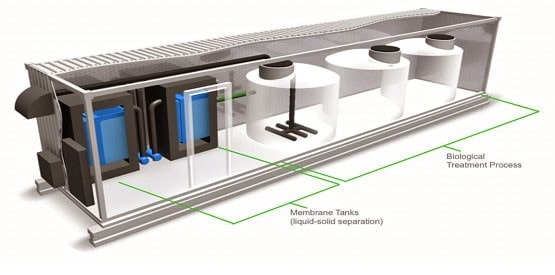
MBR Sewage Treatment Plant — Membrane Bioreactor system manufactured by Cleantech Water, Ahmedabad
What is MBR Technology? Full Form, Definition & History
MBR full form is Membrane Bioreactor. It is an advanced wastewater treatment process that integrates two distinct treatment mechanisms into a single system: biological treatment using activated sludge, and physical separation using semi-permeable membranes (microfiltration at 0.1–0.4 micron, or ultrafiltration at 0.01–0.1 micron).
In a conventional sewage treatment plant, the biological reactor and the clarifier (settler) are separate units. The activated sludge process treats the organic matter, then the mixed liquor flows to a secondary clarifier where solids settle out by gravity. The limitation: gravity settling is slow, imperfect, and sensitive to sludge bulking — and the effluent quality it produces rarely exceeds BOD 20–30 mg/L without additional polishing steps.
MBR replaces the secondary clarifier with membrane modules submerged directly in the bioreactor — or positioned externally in a separate membrane tank. The membranes do what gravity settling cannot: they physically retain all suspended solids, bacteria, and most viruses, regardless of sludge settleability. The result is effluent with BOD typically below 5 mg/L and TSS below 2 mg/L — water that can be directly discharged or reused without further polishing.
A Brief History of MBR Technology
MBR was first commercialised by Dorr-Oliver Inc. in the late 1960s using side-stream (external) membrane configurations. The technology remained expensive and niche until 1989, when Yamamoto and colleagues at the University of Tokyo demonstrated that membranes could be submerged directly inside the bioreactor — dramatically reducing energy consumption by eliminating the high-pressure recirculation pump needed for external configurations. That 1989 breakthrough is what made MBR economically viable for mid-scale projects. By the mid-1990s, commercial adoption was growing across Japan and Europe. Indian adoption accelerated after 2010, driven by NGT orders and CPCB tightening effluent discharge norms for both industrial and residential projects.
How Does an MBR Sewage Treatment Plant Work? — Stage-by-Stage Process
The MBR process moves wastewater through five stages. Each stage removes a specific category of pollutants:
| Stage | What Happens | What Is Removed |
|---|---|---|
| 1. Pre-screening | Fine screens (1–3 mm) remove rags, hair, solids before feed enters bioreactor | Large solids, fibrous material that would clog membranes |
| 2. Anoxic Zone | Denitrifying bacteria convert nitrates to nitrogen gas (N₂) — no oxygen supplied | Nitrogen (TN), nitrates — critical for sites with nitrogen discharge limits |
| 3. Aerobic Bioreactor | Aerobic bacteria consume BOD/COD in oxygen-rich mixed liquor at high MLSS (8,000–15,000 mg/L vs 3,000–5,000 in conventional) | BOD, COD, ammonia — high-efficiency removal due to elevated biomass concentration |
| 4. Membrane Filtration | Mixed liquor passes through submerged hollow-fibre or flat-sheet membranes (0.04–0.4 μm pore size) under slight vacuum | All suspended solids, bacteria, most viruses, protozoa — physical barrier removes what biology cannot |
| 5. Disinfection | UV or chlorination applied to membrane permeate before storage or discharge | Remaining pathogens — ensures microbiologically safe output |
Why high MLSS matters in MBR
Conventional activated sludge systems operate at MLSS of 3,000–5,000 mg/L — higher concentrations cause settleability problems in the secondary clarifier. Because MBR eliminates the clarifier, it can operate at MLSS of 8,000–15,000 mg/L. More biomass per unit volume means higher BOD/COD removal rates in a smaller footprint. This is why MBR plants can be 30–50% smaller than equivalent conventional systems.
MBR vs MBBR vs SBR — Which Technology Is Right for Your Project?
This is the question we get most often from clients comparing quotes. The right answer depends on your effluent quality requirement, available footprint, budget, and whether treated water reuse is in scope. Here is an honest comparison — based on what we have observed across 150+ installations, not manufacturer data sheets:
| Parameter | MBR | MBBR | SBR |
|---|---|---|---|
| Effluent BOD | <5 mg/L | 10–20 mg/L | 10–20 mg/L |
| Effluent TSS | <2 mg/L | <30 mg/L | <30 mg/L |
| Footprint | Smallest | Compact | Very compact |
| Capital cost/KLD | ₹80,000–₹1,50,000 | ₹40,000–₹80,000 | ₹55,000–₹95,000 |
| Energy use | Highest (1–1.5 kWh/KLD) | Medium (0.5–0.8 kWh/KLD) | Medium-high |
| Membrane replacement | Every 5–8 years (₹80K–₹2.5L) | No membranes | No membranes |
| Variable load handling | Good | Excellent | Excellent |
| Water reuse suitability | Highest — flushing, cooling towers, irrigation | Irrigation, flushing (with UV) | Irrigation, flushing (with UV) |
| Best for | Luxury hotels, pharma campuses, eco-resorts, water-scarce locations | Most residential + commercial projects | Space-constrained sites, automation priority |
Our recommendation: choose MBR only when water reuse quality is a hard requirement. For the majority of Indian residential, commercial, and industrial projects, MBBR delivers better value. MBR’s effluent quality premium costs 2–3x more in capital and 40–60% more in operating cost — worth it when the use case demands it, not as a default upgrade.
Features of Cleantech Water’s MBR Sewage Treatment Plant
Our MBR sewage treatment plant is configured for Indian site conditions — variable inlet quality, occasional power interruptions, and CPCB compliance documentation requirements that differ from international project norms:
- Online backwash system — automatic membrane cleaning cycle prevents fouling buildup without shutting down the plant
- Fine screening at inlet — 1–3 mm screens protect membrane integrity and extend membrane life significantly
- High-quality permeate — BOD <5 mg/L, TSS <2 mg/L, Total Coliform <10 MPN/100 mL — suitable for toilet flushing, car washing, cooling tower makeup
- No separate settler/clarifier required — reduces civil footprint by 30–50% compared to conventional STP
- Underground and above-ground configurations — both available for hotel, residential, and campus applications
- PLC-based automation — permeate flux monitoring, transmembrane pressure (TMP) alerts, automatic backwash scheduling
- CPCB performance documentation — effluent quality reports provided at commissioning for consent-to-operate applications
MBR Technology — Advantages and Disadvantages (Honest Assessment)
Advantages of MBR Sewage Treatment Plant
- Highest effluent quality available — BOD <5 mg/L, TSS <2 mg/L consistently. No other biological treatment technology matches this without additional polishing steps
- Smallest footprint — high MLSS concentration (8,000–15,000 mg/L) means the bioreactor volume needed per unit of BOD load is 30–50% less than conventional systems
- Treated water directly reusable — MBR permeate meets CPCB Class A standards and can be used for toilet flushing, irrigation, car washing, and cooling tower makeup without further treatment
- Less sludge generation — higher SRT (sludge retention time) in MBR leads to more complete mineralisation of organic matter, reducing sludge volumes by 30–50% versus conventional activated sludge
- Better pathogen removal — membrane physically removes bacteria and most viruses — conventional clarifiers cannot do this without chemical dosing
Disadvantages of MBR Sewage Treatment Plant
- Higher capital cost — membrane modules add ₹40,000–₹80,000 per KLD over MBBR at equivalent capacity. For a 100 KLD plant, this is ₹40–₹80 lakh extra upfront
- Higher energy consumption — membrane scouring aeration (to prevent fouling) requires continuous air supply, adding 0.3–0.5 kWh/KLD over MBBR power consumption
- Membrane replacement cost — hollow-fibre or flat-sheet membranes have a 5–8 year service life under normal operation. Replacement cost: ₹80,000–₹2,50,000 depending on membrane type and plant capacity
- Membrane fouling sensitivity — poor pre-screening, oil/grease in the feed, or improper backwash cycles can accelerate membrane fouling and reduce flux. Fine screening at inlet is non-negotiable for MBR performance
- Requires trained operators — TMP monitoring, backwash cycle adjustment, and chemical cleaning (CIP) require operator competence beyond what a basic activated sludge plant needs
MBR STP Applications — Where It Makes Commercial Sense in India
MBR technology is not universally the best choice — it is the right choice for specific project profiles. Based on our installations across India, these are the contexts where MBR consistently justifies its higher cost:
| Application | Why MBR Is the Right Choice |
|---|---|
| Luxury hotels & eco-resorts | Treated water reused for toilet flushing, garden irrigation, spa features — reduces freshwater bills 30–40%. Compact footprint suits premium properties where land is expensive. |
| Pharmaceutical campuses | Strict CPCB/SPCB discharge norms for API effluent. MBR’s consistent low BOD/TSS output provides compliance buffer for quarterly audits. Membrane barrier adds pathogen protection for pharma hygiene standards. |
| Water-scarce locations | Properties in Rajasthan, Gujarat’s Saurashtra, or other water-stressed regions where municipal supply is restricted. MBR permeate quality enables aggressive water recycling. |
| CRZ / eco-sensitive zone projects | Coastal properties under CRZ regulations and forest zone/heritage properties under stricter NGT norms. MBR is often the only technology that meets the stringent effluent quality required. |
| Industrial ZLD projects | As a pre-treatment step before evaporators in Zero Liquid Discharge systems. MBR reduces TDS, COD, and TSS to levels that allow efficient evaporator operation and reduce evaporator scaling. |
| Automobile, oil & gas, steel industries | High-COD industrial wastewater with variable composition. MBR’s elevated MLSS handles shock loads better than conventional systems, maintaining compliance during production peaks. |
MBR Sewage Treatment Plant Cost in India (2026)
MBR cost is higher than MBBR or SBR at equivalent capacity — but the correct comparison is total cost of ownership, not just capital cost. Here are realistic 2026 market price ranges for MBR systems in India:
| Capacity | MBR Capital Cost | MBBR Capital Cost (comparison) | Monthly O&M |
|---|---|---|---|
| 5–10 KLD | ₹10–₹18 lakh | ₹6–₹12 lakh | ₹8,000–₹15,000 |
| 20–30 KLD | ₹20–₹35 lakh | ₹12–₹22 lakh | ₹18,000–₹30,000 |
| 50 KLD | ₹40–₹60 lakh | ₹22–₹35 lakh | ₹28,000–₹45,000 |
| 100 KLD | ₹70–₹1.1 crore | ₹40–₹65 lakh | ₹45,000–₹70,000 |
*MBR costs include membrane modules (hollow-fibre or flat-sheet), aeration blowers, permeate pump, backwash system, and PLC control panel. Membrane replacement (every 5–8 years) not included above. Prices exclude 18% GST and civil construction.
Frequently Asked Questions — MBR Sewage Treatment Plant
What is MBR full form in STP?
MBR full form in STP is Membrane Bioreactor. In a sewage treatment plant context, MBR refers to the technology that combines activated sludge biological treatment with membrane filtration (microfiltration or ultrafiltration) — producing treated water quality that conventional secondary clarifiers cannot match. The full form “Membrane Bioreactor Sewage Treatment Plant” is also commonly written as MBR STP.
What is the difference between MBR and MBBR?
MBR (Membrane Bioreactor) uses membranes for solid-liquid separation — producing BOD <5 mg/L and TSS <2 mg/L. MBBR (Moving Bed Biofilm Reactor) uses plastic bio-carriers to grow biofilm but still requires a secondary clarifier — producing BOD 10–20 mg/L and TSS <30 mg/L. MBR has higher capital cost (2–3x) and energy consumption, but produces significantly better effluent suitable for direct reuse without further polishing. MBBR is the more cost-effective choice for projects where discharge compliance (not water reuse) is the primary goal.
What is MBR full form in water treatment?
In water treatment, MBR full form is Membrane Bioreactor — the same as in sewage treatment. The term is specifically used for systems that combine biological treatment (aerobic or anaerobic) with membrane filtration. In pure water treatment contexts (without biological treatment), you would encounter MF (microfiltration) or UF (ultrafiltration) as standalone terms — not MBR.
What is the membrane bioreactor working principle?
The membrane bioreactor working principle combines two processes: (1) biological — aerobic bacteria consume organic matter (BOD/COD) at high mixed liquor suspended solids concentration (8,000–15,000 mg/L); (2) physical — semi-permeable membranes with 0.04–0.4 micron pore size physically retain all suspended solids, bacteria, and most viruses, replacing the conventional secondary clarifier. The permeate (clean water) is drawn through the membrane under slight vacuum (transmembrane pressure of 0.1–0.5 bar) and collected for reuse or discharge.
Is MBR better than SBR for housing societies?
For most housing societies, SBR or MBBR is the more cost-effective choice. MBR makes sense for housing societies specifically when: (a) the society needs treated water for toilet flushing and wants the highest water quality to avoid complaints; (b) the site is in a water-scarce area and aggressive water recycling is the goal; (c) the building bye-laws or PCB consent conditions specify a BOD discharge limit tighter than 20 mg/L. In all other cases, the 2–3x higher capital cost of MBR is difficult to justify on a per-flat basis in a residential project.
How long do MBR membranes last?
MBR membranes (hollow-fibre or flat-sheet) typically have a service life of 5–8 years under normal operating conditions — defined as proper fine screening at inlet, consistent DO maintenance in the bioreactor, regular backwash cycles, and periodic chemical cleaning (CIP every 3–6 months). Poor pre-screening, high oil/grease in the feed, or irregular backwash schedules can reduce membrane life to 2–3 years. Membrane replacement cost ranges from ₹80,000 to ₹2,50,000 depending on membrane type and plant capacity.
Considering an MBR Sewage Treatment Plant?
Cleantech Water has installed MBR systems for hotels, pharma campuses, and housing societies across Gujarat and India. We’ll advise whether MBR is actually right for your project — or whether MBBR or SBR delivers better value. Free site assessment available.
We, Cleantech Water, are a wastewater treatment plant manufacturer in Ahmedabad, Gujarat, with 13+ years and 150+ installations across India. For queries about MBR sewage treatment plant systems — sizing, cost, or whether MBR is the right technology for your specific project — contact us at +91-9558996411 or Info@cleantechwater.co.in.