

What does a ZLD plant cost in India?
ZLD plant cost in India ranges from ₹1.5 crore for a 50 KLD system to ₹100 crore or more for a 2 MLD+ industrial installation. The wide range reflects effluent TDS (the primary cost driver), technology choice (MEE vs MVR), and whether a crystalliser is required for final salt removal. ZLD costs 3–5x more than a standard ETP of identical capacity — the premium is almost entirely in the evaporation and salt-recovery stages, not the biological pre-treatment.
Zero Liquid Discharge is one of those compliance requirements that surprises industries twice: first when they discover it applies to them, and second when they see the capital cost. Both surprises are avoidable with early planning — and the second one is more manageable than it appears once you understand what actually drives ZLD plant cost in India and which government grant programmes exist to offset it.
At Cleantech Water, we have been designing wastewater treatment systems for Gujarat’s industrial clusters since 2013 — including industries in Surat’s dyeing zones, Ankleshwar’s chemical GIDC, and Vapi’s mixed-industry estates that face ZLD mandates from GPCB. The numbers in this guide come from that project experience, adjusted to 2026 equipment and construction costs. We have also tried to be honest where ZLD is the right investment and where a well-designed standard effluent treatment plant is the more appropriate solution — because ZLD is not the right answer for every industry, and recommending it where it isn’t needed wastes your capital.
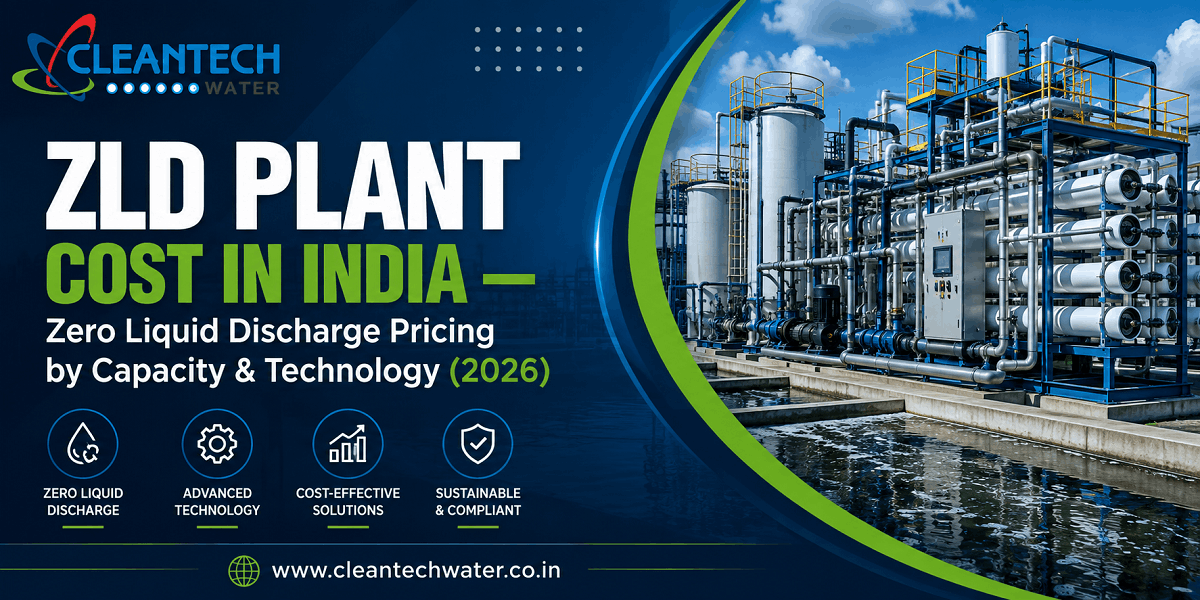
Why Does a ZLD Plant Cost So Much More Than a Standard ETP?
Understanding the cost difference starts with understanding what ZLD actually does that a standard ETP does not. A conventional effluent treatment plant removes organic pollutants (BOD/COD), suspended solids, and some dissolved contaminants from wastewater — then discharges the treated water to a drain, sewer, or water body. The water leaves the site as effluent.
ZLD does something fundamentally different: it eliminates liquid discharge entirely. Every litre of water that enters the ZLD system comes back out either as reusable process water or as dry solid waste (salt cake, crystalline solids). There is no liquid effluent — hence “zero liquid discharge.”
Achieving this requires treatment stages that a standard ETP simply does not have:
| Treatment Stage | Standard ETP | ZLD System | Cost Addition |
|---|---|---|---|
| Biological treatment (MBBR/SBR) | ✅ | ✅ | Base cost |
| Primary clarification + chemical treatment | ✅ | ✅ | Base cost |
| Reverse Osmosis (RO) — concentrate and recover water | ❌ | ✅ | +40–80% over base ETP |
| Evaporation (MEE or MVR) — concentrate brine | ❌ | ✅ | +100–200% over base ETP |
| Crystalliser / ATFD — dry salt recovery | ❌ | ✅ (for true ZLD) | +50–100% over evaporation stage |
The evaporation stage is where ZLD cost is truly set. Concentrating dissolved solids in water to the point where they crystallise out as solids requires enormous amounts of thermal energy — and energy costs money. A 100 KLD ZLD system consumes 80–100 kWh of energy per cubic metre of water treated, compared to 0.5–1.5 kWh/m³ for a standard biological ETP. That 50–100x energy difference explains most of the capital and operating cost premium.
ZLD Plant Cost in India by Capacity — 2026 Price Reference
The following reflects realistic 2026 installed costs for complete ZLD systems (ETP pre-treatment + RO + evaporation + crystalliser) for moderate-TDS effluent (3,000–10,000 mg/L TDS). High-TDS effluent above 30,000 mg/L (textile spent dye bath, distillery spent wash) adds 30–60% to these figures:
| ZLD Capacity | Suitable For | Capital Cost (ZLD) | Equivalent Standard ETP |
|---|---|---|---|
| 20–50 KLD | Small pharma, specialty chemical, electroplating | ₹1.5–₹5 crore | ₹15–₹40 lakh |
| 100 KLD | Mid-size textile dyeing, pharma API, dye intermediate | ₹4–₹10 crore | ₹70 lakh–₹1.2 crore |
| 250 KLD | Large textile unit, chemical complex, sugar mill | ₹10–₹25 crore | ₹1.5–₹4.5 crore |
| 500 KLD | Textile cluster CETP, large pharma campus, distillery | ₹20–₹50 crore | ₹4–₹8 crore |
| 1 MLD | Large industrial estate, major textile processing hub | ₹40–₹80 crore | ₹8–₹15 crore |
| 2 MLD+ | CETP for industrial zone, large paper/pulp, refinery | ₹80–₹150 crore+ | ₹15–₹30 crore |
*Capital costs include ETP pre-treatment, RO system, evaporation (MEE/MVR), and crystalliser/ATFD. Excludes civil construction (add 30–40% for greenfield), 18% GST, and land. High-TDS effluent (textile spent dye, distillery spent wash) adds 30–60% to above figures. Contact Cleantech Water for site-specific budgeting.
MEE vs MVR — Which Evaporation Technology and What Does Each Cost?
The evaporation stage is the largest single cost component in any ZLD system — and the choice between Multiple Effect Evaporation (MEE) and Mechanical Vapour Recompression (MVR) has the biggest impact on both capital cost and monthly operating bills. This decision is worth understanding before you receive vendor quotations.
Multiple Effect Evaporation (MEE)
MEE uses steam (generated from a boiler) to evaporate water from the brine concentrate in a series of vessels (effects). Each subsequent effect operates at lower pressure and temperature, using the vapour from the previous effect as its heating medium — multiplying the energy efficiency of a single-effect evaporator. A triple-effect MEE uses roughly one-third of the steam that a single-effect unit would need for the same evaporation duty.
MEE is the established, well-proven choice for ZLD in India — most existing installations in Gujarat’s textile and chemical clusters use MEE. It handles high-TDS and high-viscosity concentrates reliably. The downside is steam dependency: MEE requires a live steam supply, which means either an existing boiler on-site or a dedicated steam generator as part of the ZLD plant. Industries with no existing steam infrastructure face significant additional cost for this.
Mechanical Vapour Recompression (MVR)
MVR replaces steam with electrical energy. A mechanical compressor recompresses the vapour generated during evaporation and feeds it back as the heating medium — creating a near-closed energy loop. Once running, MVR consumes 8–15 kWh per cubic metre of water evaporated, versus 30–50 kWh/m³ for MEE (equivalent thermal energy). Running cost savings of 50–60% over MEE are achievable in India’s current industrial electricity pricing environment.
MVR’s limitation is capital cost: the compressor and its drive system add ₹1.5–₹4 crore to the evaporator cost relative to MEE at equivalent capacity. And MVR is sensitive to scaling — it requires very careful pre-treatment to keep the evaporator heat transfer surfaces clean. For new ZLD installations above 100 KLD where electricity is the primary energy source and steam is not available, MVR is now the preferred choice on a lifecycle cost basis.
| Factor | MEE | MVR |
|---|---|---|
| Capital cost (100 KLD evaporator) | ₹3–₹6 crore (lower) | ₹5–₹9 crore (higher) |
| Energy source | Steam (boiler needed) | Electricity only |
| Operating energy (per m³ evaporated) | 30–50 kWh/m³ | 8–15 kWh/m³ |
| Monthly operating cost saving vs MEE | — | 50–60% lower |
| Scaling sensitivity | More tolerant | Sensitive — pre-treatment critical |
| Best for | Existing steam users, high-TDS effluent, smaller ZLD | New installations >100 KLD, no steam, electricity available |
ZLD Plant Monthly Operating Cost (OPEX) — What to Budget
Monthly operating cost is where ZLD’s economics become the most challenging. Energy is the dominant cost — evaporation is inherently energy-intensive, and there is no engineering shortcut around it. Here are realistic 2026 monthly OPEX ranges for ZLD systems in India:
| ZLD Capacity | Monthly OPEX (MEE) | Monthly OPEX (MVR) | Water Recovered (90%) |
|---|---|---|---|
| 50 KLD | ₹4–₹7 lakh | ₹2–₹3.5 lakh | 45 KLD/day reused |
| 100 KLD | ₹7–₹14 lakh | ₹3.5–₹7 lakh | 90 KLD/day reused |
| 250 KLD | ₹18–₹35 lakh | ₹9–₹18 lakh | 225 KLD/day reused |
| 500 KLD | ₹35–₹65 lakh | ₹18–₹35 lakh | 450 KLD/day reused |
*OPEX includes energy, chemicals, salt disposal at authorised TSDF (₹3,000–₹8,000/tonne), operator cost, and AMC charges. Excludes major equipment overhaul (budget separately every 5–7 years).
Is ZLD Mandatory for Your Industry? — CPCB & GPCB Requirements (2026)
ZLD is not required for all industries — and one of the most useful things we can tell a prospective client is whether they actually need a ZLD system or whether a well-designed conventional ETP meeting CPCB discharge standards is the right solution. Here is the current mandatory status by industry:
Industries Where ZLD Is Mandatory or Effectively Required
| Industry | Mandate | Gujarat Relevance |
|---|---|---|
| Textile dyeing & processing | CPCB 2015 direction + GPCB consent condition | High — Surat, Ahmedabad dyeing clusters |
| Dye & dye intermediate manufacturers | CPCB + GPCB for Ankleshwar & Vapi clusters | Very High — Ankleshwar GIDC, Vapi GIDC |
| Pharmaceutical (API manufacturing) | NGT orders + CPCB 2022 direction (near water bodies) | Medium — Ankleshwar, Vadodara pharma units |
| Distilleries | CPCB 2015 — biomethanation + ZLD for spent wash | Medium — sugar belt districts |
| Tanneries | CPCB + SPCB — chrome recovery mandatory | Low — limited tanneries in Gujarat |
| Chemical manufacturers (near water bodies) | GPCB CTO condition — case by case | High — Vapi, Ankleshwar, Vatva clusters |
Industries Where Standard ETP Is Usually Sufficient
Food processing, dairy, residential sewage, hospitals, hotels, engineering/automobile manufacturing (for sanitary sewage) — these generally do not require ZLD under current CPCB/GPCB norms. A properly designed sewage treatment plant or effluent treatment plant meeting CPCB Class A discharge standards (BOD <30 mg/L, COD <250 mg/L, TSS <100 mg/L) is what these industries need — not a ZLD system. If a vendor is quoting ZLD for a food processing or residential project without a specific SPCB condition requiring it, ask them to show you the regulatory basis.
GPCB 2026 enforcement note: GPCB has significantly intensified ZLD enforcement in the Ankleshwar, Vapi, and Vatva GIDC zones since 2024. Industries in these clusters whose Consent to Operate is due for renewal are being required to demonstrate ZLD compliance — or ZLD installation in progress — as a condition of CTO extension. If your CTO renewal is within 18 months, start ZLD project planning now. Installation and commissioning typically takes 12–20 months from order placement.
Government Grants & Subsidies for ZLD Plants in India — Reduce Your Capital Cost
One aspect of ZLD investment that most industries overlook is the availability of government subsidies that can meaningfully reduce the capital outlay. The most significant is the Integrated Processing Development Scheme (IPDS) administered by the Ministry of Textiles:
IPDS (Integrated Processing Development Scheme)
IPDS provides grants of up to 50% of project cost for ZLD infrastructure in textile processing clusters, subject to a maximum grant of ₹75 crore per project. This is specifically targeted at Common Effluent Treatment Plants (CETPs) in textile clusters upgrading to ZLD compliance. For a ₹30 crore ZLD project in a textile cluster, IPDS could cover ₹15 crore — transforming the investment economics significantly.
Eligibility conditions: the project must be in a textile CETP or cluster setting, the CETP must be an SPV (Special Purpose Vehicle) with member industries, and the ZLD system must comply with CPCB’s Zero Liquid Discharge guidelines. Applications are processed through the Textile Committee and the respective State Textile Department.
State-Level Grants (Gujarat)
GPCB and the Gujarat government have periodically offered grants and soft loans through GIDC for ZLD installation in notified polluted clusters (Vapi, Ankleshwar). Check with GPCB’s regional office for current scheme availability — these programmes are revised periodically and what’s available in 2026 may differ from published scheme details from prior years.
ZLD Plant ROI — Does It Pay Back in India?
The honest answer is: it depends on your water cost and whether you are buying freshwater or pumping from a borewell. Here is how the calculation typically works for a 100 KLD ZLD system:
| Factor | Calculation | Annual Value |
|---|---|---|
| Water recovered (90% of 100 KLD) | 90,000 litres/day × 300 working days | 2,70,00,000 litres/year |
| Freshwater cost saved (GIDC tanker rate ₹0.08/litre) | 2.7 crore litres × ₹0.08 | ₹21.6 lakh saved |
| ZLD operating cost (MVR, 100 KLD) | ₹5 lakh/month × 12 | ₹60 lakh/year |
| Net annual ZLD cost (OPEX − water savings) | ₹60L − ₹21.6L | ₹38.4 lakh/year |
| ZLD capital cost (100 KLD, MVR) | Indicative | ₹6–₹10 crore |
*Simple payback on water savings alone: 25–40 years (₹6–₹8 crore capital ÷ ₹21.6 lakh annual water saving). This is why ZLD rarely pays back purely on water savings for most Indian industries — the genuine ROI case comes from regulatory compliance value (avoiding closure, fines, CTO refusal) and export/supply chain compliance for industries where international buyers require ZLD certification.
The business case for ZLD in India is primarily a regulatory risk mitigation argument, not a water-savings argument. For industries facing CTO refusal, NGT penalties, or closure orders, the cost of non-compliance — lost production, legal costs, fines — dwarfs the capital cost of ZLD. For export-oriented textile units where buyers require ZLD compliance as a sourcing condition, ZLD becomes a revenue-protection investment. In both cases, the payback calculation looks very different from a pure operational savings analysis.
Frequently Asked Questions — ZLD Plant Cost India
What is the cost of a 100 KLD ZLD plant in India?
A 100 KLD Zero Liquid Discharge plant in India costs approximately ₹4–₹10 crore depending on effluent TDS, technology choice (MEE vs MVR), and whether a crystalliser is required. MEE-based systems for moderate-TDS effluent (3,000–10,000 mg/L) fall in the ₹4–₹7 crore range; MVR-based systems cost ₹6–₹10 crore with lower monthly operating costs. High-TDS textile or distillery effluent can push 100 KLD ZLD costs to ₹12–₹18 crore. Monthly operating cost for a 100 KLD ZLD runs ₹7–₹14 lakh (MEE) or ₹3.5–₹7 lakh (MVR).
Is ZLD mandatory for textile industries in Gujarat?
Yes — ZLD is mandatory for textile dyeing and processing units in Gujarat under GPCB consent conditions, consistent with CPCB’s 2015 directive. Surat’s dyeing cluster and Ahmedabad’s printing units are actively required to demonstrate ZLD compliance as a condition of Consent to Operate renewal. GPCB has intensified enforcement since 2024, with CTO extensions being withheld for units that cannot show ZLD installation in progress. Textile units in Gujarat should treat ZLD as a compliance certainty, not a contingency.
What is the difference between MEE and MVR in a ZLD plant?
MEE (Multiple Effect Evaporation) uses steam to concentrate brine — it has lower capital cost (₹3–₹6 crore for 100 KLD evaporator) but higher monthly energy cost (30–50 kWh/m³). MVR (Mechanical Vapour Recompression) uses electricity to recompress evaporated vapour — higher capital cost (₹5–₹9 crore for 100 KLD) but 50–60% lower monthly operating cost (8–15 kWh/m³). For new installations above 100 KLD without existing steam infrastructure, MVR is preferred on a 10-year total cost of ownership basis.
Are there government subsidies for ZLD plants in India?
Yes — the IPDS (Integrated Processing Development Scheme) from India’s Ministry of Textiles provides grants of up to 50% of ZLD project cost, subject to a maximum grant of ₹75 crore per project. This scheme targets textile processing clusters and CETPs installing ZLD systems. State-level grants and soft loans are periodically available through GPCB and GIDC for industries in notified polluted clusters (Vapi, Ankleshwar). Contact Cleantech Water for help navigating current grant availability for your specific project.
What is the water recovery rate of a ZLD plant?
A well-designed ZLD system achieves 90–95% water recovery — meaning 90–95 litres of every 100 litres of wastewater input is recovered as reusable process water. The remaining 5–10% exits as dry solid waste (salt cake, crystalline solids) that is disposed of at authorised Treated Storage and Disposal Facilities (TSDF) under CPCB’s Hazardous Waste Management Rules. Salt recovery and potential resale is possible for certain effluent types (textile brine containing sodium chloride) — a revenue offset that some industries can realise.
How long does it take to install a ZLD plant in India?
A complete ZLD plant (ETP + RO + evaporation + crystalliser) takes 12–20 months from order placement to commissioning — longer than a standard ETP because evaporators and crystallisers are custom-engineered equipment with longer fabrication lead times. Industries under active GPCB notices with short compliance windows should engage ZLD vendors immediately. Preliminary engineering and procurement can begin while SPCB approval is in process — compressing the overall timeline by 2–3 months.
Get a ZLD Cost Estimate for Your Industry
Cleantech Water has designed wastewater treatment systems for Gujarat’s industrial clusters — including ZLD-ready systems for Ankleshwar and Vapi industries. We assess your effluent, your regulatory position, and your budget before recommending a technology. Free techno-commercial assessment available.
ZLD plant cost in India is genuinely high — and the gap between a standard ETP and a full ZLD system is not a pricing anomaly but a reflection of what evaporation physics actually costs in energy and equipment. For industries facing GPCB or CPCB ZLD mandates in Gujarat’s industrial clusters, the question is not whether to invest but how to minimise total cost of ownership over the system’s 15-year life — and that decision hinges on MEE vs MVR selection, pre-treatment quality, and whether government grant programmes like IPDS are leveraged effectively.
For industries not currently under a ZLD mandate, the right investment is a well-designed conventional ETP that meets CPCB discharge standards — not an over-specified ZLD system. At Cleantech Water, we help clients understand which category they fall into before recommending a technology, because the wrong recommendation costs more than the right one — in both capital and operating terms. Contact us at +91-9558996411 or Info@cleantechwater.co.in for a free assessment of your ZLD requirement.
Vipul Chavda — Co-Founder, Cleantech Water
Vipul has 13+ years of experience designing wastewater treatment and ZLD-ready systems for industrial clients across Gujarat — including chemical manufacturers in Ankleshwar, textile processors in Surat, and pharmaceutical units in Vadodara. Cleantech Water has completed 150+ water treatment installations for clients including GIFT City, Adani, TATA, Mother Dairy, L&T, and Arvind Group.