

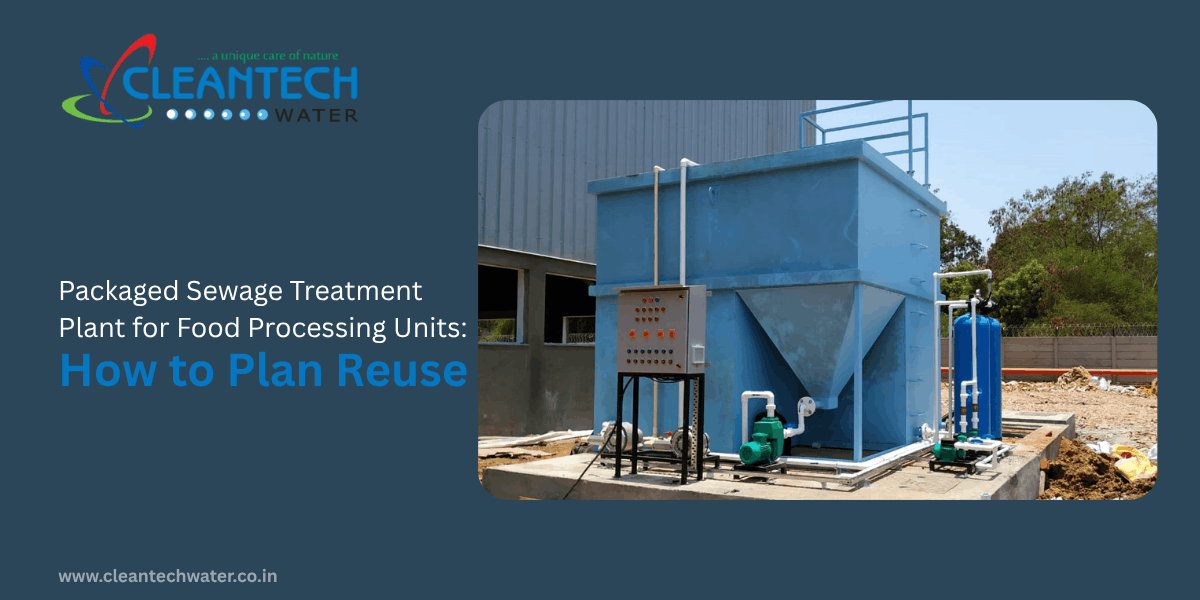
Food processing plants do not generate just one kind of wastewater. A single facility can produce toilet sewage from staff areas, canteen wastewater with grease, washdown flows from utility spaces, and high-strength process effluent from production lines. That is why many factories make a costly planning mistake: they start looking for a packaged sewage treatment plant before separating what should go to an STP and what should go to an ETP.
For a food processing unit, the better question is not, “Which packaged sewage treatment plant should we buy?” The better question is, “Which wastewater streams on this site are actually suitable for the plant, what pre-treatment is needed, and how will the treated water be reused?” That shift in thinking leads to better plant performance, fewer odour and clogging issues, more stable treatment, and a system that is easier to operate over time.
This is where food processing units need a more specific approach than other commercial sites. A factory may have variable shifts, sanitation cycles, canteen discharge, and production-related wastewater of very different strengths. So while sewage treatment plants are common across many sectors, the way they should be planned for food processing is far more application-specific.
Why Food Processing Units Need a Different Wastewater Strategy
A food factory is not an apartment complex, an office campus, or a hotel. Production schedules change, cleaning cycles create sudden surges, and canteens add oil and grease. Some facilities run seasonal production, which means wastewater quantity and quality can fluctuate throughout the year.
That is why a food-processing site should never treat all wastewater as one combined stream. Domestic sewage from toilets and washrooms is one category. Processing wastewater from dairy, meat, fruit, vegetable, beverage, or oil-based operations is another. Kitchen and canteen discharge is a third category because grease can destabilise compact treatment systems if it is not intercepted early.
In practical terms, the performance of sewage treatment plants in food facilities depends as much on stream segregation and pre-treatment as it does on the treatment technology itself.
Where a Packaged Sewage Treatment Plant Fits in a Food Factory
A packaged sewage treatment plant is usually the right fit for sanitary sewage and other compatible low-strength wastewater streams, such as:
- Staff toilets and washrooms
- Admin block sewage
- Worker welfare areas
- Pantry and canteen wastewater after grease control
- Dormitory or accommodation blocks inside factory premises
- Decentralised utility or expansion blocks, where a compact system is preferred
These applications suit packaged systems because the wastewater is closer to domestic sewage in nature and easier to stabilise with compact biological treatment.
The problem begins when high-strength production effluent is mixed into the same line. Process wastewater in food units often contains higher organic load, suspended solids, fats, oils, grease, detergents, and variable pH. In such cases, a packaged sewage treatment plant may still be the right choice for sanitary sewage, but not for all wastewater generated on site.
When a Packaged Sewage Treatment Plant Alone Is Not Enough
A compact STP should not be treated as a shortcut for every wastewater challenge on a food site. It is usually not enough on its own when the plant is dealing with:
- Dairy-rich wastewater
- Whey, milk solids, or sugar-rich discharge
- Meat or poultry process wastewater
- Oil- and fat-heavy streams
- CIP discharge with chemicals
- Raw material washing with high suspended solids
- Seasonal or batch-driven shock loads
In such cases, the unit may still need a packaged sewage treatment plant for sanitary sewage, but the process effluent should be handled separately through pre-treatment and, where required, a dedicated ETP route.
STP vs ETP in Food Processing Units: What Goes Where?
One of the biggest points of confusion in this sector is deciding which wastewater should go to an STP and which should go to an ETP. The table below simplifies that decision.
|
Wastewater Stream |
Best Route |
Reason |
| Staff toilets and washrooms | Packaged sewage treatment plant | Mostly sanitary sewage |
| Admin block wastewater | Packaged sewage treatment plant | Predictable domestic load |
| Canteen discharge after the grease trap | Packaged sewage treatment plant | Can be compatible after grease control |
| Worker dormitory sewage | Packaged sewage treatment plant | Similar to domestic sewage |
| CIP discharge | ETP or separate pre-treatment | May contain chemicals and a higher load |
| Dairy or milk handling wastewater | ETP or specialised treatment | High BOD/COD and fats |
| Process floor wash with food solids | ETP or pre-treatment first | Solids and organics can shock biology |
| Oil- or fat-heavy wastewater | ETP or grease separation | Needs stronger front-end removal |
This is one of the most important planning principles for food factories. If the segregation is wrong, even a good packaged sewage treatment plant will struggle in operation. If the segregation is right, even a relatively compact system can run reliably and efficiently.
First Step Before Buying: Map the Streams, Not Just the KLD
Many buyers ask for a “10 KLD” or “25 KLD” unit too early. In a food-processing facility, KLD is only part of the story. The better starting point is a wastewater map.
Before sizing the system, ask:
- How many employees work per shift?
- Are sanitary and process drains already separated?
- Is there a canteen or kitchen?
- Are there staff accommodation areas?
- Does production vary by season?
- Is future expansion planned in the next 12 to 24 months?
- Will treated water be reused or only discharged?
This matters because design is not just about average daily flow. It is about peak flow, load shocks, and stream compatibility.
A Simple Capacity Example
Suppose a food unit has 180 staff members across shifts, and you estimate 45 litres per person per day for sanitary use from toilets and washrooms.
180 × 45 = 8,100 litres/day = 8.1 KLD
Now add canteen wastewater after grease trapping and keep a design margin for peak usage and moderate future expansion. In many such cases, a small sewage treatment plant in the 10 to 12 KLD range may make more sense than selecting an 8 KLD system too tightly.
This is a simple planning example, not a fixed formula for every site. The real takeaway is that correct sizing must follow actual site use, not just a round number on a purchase inquiry.
Pre-Treatment Requirements That Make or Break Performance
In food-processing facilities, pre-treatment is not optional. It is often the difference between a stable plant and a maintenance problem.
Grease Control for Canteen and Kitchen Wastewater
Food-service wastewater should not enter a compact STP untreated. Grease can coat media, reduce oxygen transfer, clog pipes, and increase odour complaints. That is why kitchen and canteen wastewater should pass through a grease trap or similar pre-treatment step before entering the packaged sewage treatment plant.
Screening and Solids Removal
Solid materials such as food residue, peels, packing debris, and washdown waste should be removed before they reach the treatment system. Screening protects pumps, reduces blockages, and lowers the organic load entering the biological stage.
Equalisation for Flow Stability
A packaged sewage treatment plant on a food site often sees uneven loading due to shift changes, lunch hours, sanitation cycles, or weekly cleaning surges. Equalisation helps absorb these variations before they reach the biological process. This improves consistency and reduces the risk of process upset.
What to Look for in a Packaged Sewage Treatment Plant for Food Processing Units
Not every compact treatment system is suitable for this environment. The right packaged sewage treatment plant for a food unit should be selected based on operational realities, not only brochure specifications.
Prioritise These Features
- Reliable odour control
- Easy access for cleaning and inspection
- Automation with alarms for pump or blower faults
- Compatibility with segregated and pre-treated inlet streams
- Stable performance under partial and peak load conditions
- Practical sludge handling
- Reuse-ready tertiary polishing where required
These features matter more in food-processing environments because wastewater infrastructure often sits closer to hygiene-sensitive operations. A plant that is hard to clean, difficult to access, or prone to smell can quickly become an operational nuisance.
Why Modular Design Works Well
A packaged sewage treatment plant is often a strong fit for food units because it is compact, faster to install, and easier to expand than a fully civil-heavy conventional setup. This is useful where land is limited, production is ongoing, or utility areas are already crowded.
This is also where a small sewage treatment plant becomes commercially important. A small plant may be ideal for a staff block, canteen area, annex building, or utility section, especially where a full centralised plant is unnecessary or impractical.
Reuse Opportunities Inside the Plant Premises
A good wastewater strategy should not stop at treatment. It should ask what part of the treated water can replace fresh water on-site.
For a food-processing unit, treated water from a properly designed packaged sewage treatment plant may be considered for non-potable applications such as:
- Toilet flushing
- Gardening and landscaping
- Road washing
- Selected housekeeping or utility uses, depending on treatment level and site requirements
The main point is that reuse planning should happen before final design, not after commissioning. Once the intended reuse points are known, the system can be designed with the right storage, pumping, and polishing steps. If reuse is treated as an afterthought, the site often ends up underusing treated water and missing long-term savings.
Compliance, Hygiene, and Odour: The Overlooked Decision Factors
Most buyers focus first on capacity and price. In reality, wastewater systems at food-processing sites are often judged on three simpler questions:
- Does it smell?
- Does it stay stable in daily operation?
- Does it create housekeeping or hygiene concerns near production and staff areas?
That is why odour control, sludge management, easy maintenance, and simple operating logic matter so much in this sector.
Before finalising a system, buyers should ask:
- Which influent assumptions were used in the design?
- Is kitchen wastewater pre-treated for grease?
- What happens during peak staff usage?
- How much sludge will require removal?
- Who will operate the system on a daily basis?
- What treated-water quality is expected for the intended reuse or discharge route?
A low-price system that ignores these questions often becomes the more expensive choice after a few months of operation.
7 Questions to Ask Before Choosing a Packaged Sewage Treatment Plant for a Food Factory
Before selecting a packaged sewage treatment plant, ask these questions:
- Have we fully separated sanitary sewage from process effluent?
- Is canteen wastewater passing through a grease trap?
- What is our real peak sewage load by shift and by day?
- Are seasonal production changes likely to affect the plant?
- Do we need a small sewage treatment plant for a satellite block or one centralised system?
- Where exactly will treated water be reused?
- Who will own the operation and maintenance after commissioning?
These are real decision-stage questions. A supplier that can answer them clearly is usually thinking like a project partner, not just an equipment seller.
Final Thoughts
A packaged sewage treatment plant can be an excellent solution for food-processing units, but only when it is used for the right wastewater streams. The biggest success factor is not just the treatment technology. It is correct segregation between sewage-like streams and high-strength process effluent, supported by grease control, screening, equalisation, and realistic reuse planning.
That is also the real difference between the content of generic sewage treatment plants and a project-ready wastewater strategy for the food industry. In this sector, treatment performance is closely tied to site hygiene, operator workload, utility planning, and long-term reuse value.
A well-chosen packaged sewage treatment plant helps reduce freshwater demand, supports cleaner site operations, and makes wastewater infrastructure easier to manage without overbuilding the system. In the right application, even a small sewage treatment plant can deliver strong value when it is sized correctly and connected to the right wastewater stream.
If your food-processing facility is planning a new line, an expansion block, or a wastewater upgrade, the smartest first step is to assess the wastewater streams before selecting equipment. That is what leads to a solution that performs well not only on paper, but in day-to-day plant operation.
Frequently Asked Questions (FAQs)
1. Can a packaged sewage treatment plant treat all wastewater from a food processing unit?
No. It is usually best suited for sanitary sewage and compatible low-strength streams. High-strength process effluent often needs separate pre-treatment or an ETP route.
2. Why is grease control important before treatment?
Grease can clog pipelines, create odour, and interfere with biological treatment. That is why kitchen and canteen discharge should be pre-treated before entering the plant.
3. Can a small sewage treatment plant work inside a food factory?
Yes. A small sewage treatment plant can work well for staff blocks, utility annexes, canteens after grease control, or decentralised accommodation areas, provided the wastewater is sewage-like and not mixed with strong process effluent.
4. Can treated water be reused inside a food-processing premises?
Yes, for selected non-potable uses such as flushing, landscaping, road washing, and some utility applications, depending on treatment quality and site requirements.
5. What matters more than just KLD sizing?
Segregation, pre-treatment, peak-load planning, odour control, and reuse strategy matter just as much as plant capacity.
Build the Right Wastewater Solution with Cleantech Water
If your food processing facility is planning a new wastewater system, expanding a utility block, or upgrading an underperforming setup, Cleantech Water can help you choose a solution that fits your site, load profile, and reuse goals. The company positions itself as a wastewater, industrial water, and sewage treatment plant manufacturer based in Ahmedabad, serving clients across India, with solutions including:
- Sewage treatment plants
- SBR
- MBBR
- Grey water treatment
- Effluent treatment
- Packaged systems
Every solution we offer is tailored to required discharge quality.
Instead of forcing a generic system into a complex food-processing environment, work with a team that understands segregation, compact installation, operational efficiency, and long-term performance.
Cleantech Water also highlights installation, optimization, and maintenance support, which matters when you need a packaged sewage treatment plant that performs reliably beyond commissioning.
Contact us at +91-9099915539 / +91-9558996411 or drop us an email at Info@cleantechwater.co.in to discuss your wastewater streams, treatment goals, and reuse plan, and move forward with a practical, industry-ready solution built for real operating conditions.