

Water quality plays a major role in overall plant performance, equipment durability, and long-term operating expenses. In industrial systems, even small amounts of suspended solids and turbidity can create bigger problems downstream by fouling membranes, increasing pressure drop, and reducing process stability. In water science terms, turbidity is the reduced clarity caused by suspended particles, and suspended solids are the particles that remain in the water and need to be removed through filtration.
That is why the filtration stage matters so much in an industrial water treatment system. Whether the plant handles RO feed, cooling water, effluent polishing, or process water, the first filtration step often decides how hard the rest of the treatment train must work. Industry filtration design practices indicate that pressure filters and multimedia filters operate at different service flow ranges, which is one reason they perform differently in industrial applications.
The two most common options are the pressure sand filter and the multi-media water filter. Both remove solids, but they do not perform the same way. The right choice depends on feedwater quality, turbidity load, flow demand, backwash needs, and the sensitivity of downstream equipment.
Direct Answer:
A pressure sand filter is usually the better fit for straightforward suspended solids removal and moderate turbidity control, while a multi-media water filter is the better choice when the water quality is more variable, the solids are finer, or the downstream system needs stronger clarification and higher dirt-holding capacity.
What Is a Pressure Sand Filter?
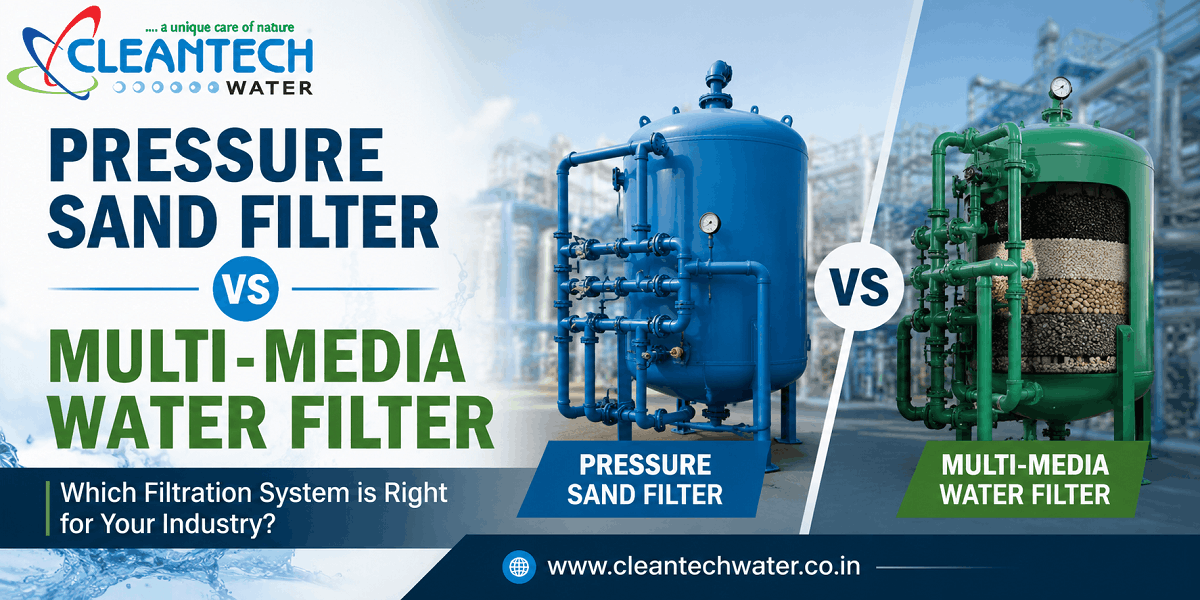
A pressure sand filter is a closed filtration vessel that uses sand as the main media to trap suspended solids as water passes through it under pressure. In industrial use, it is often applied as a pressure sand filtration unit in pre-treatment, polishing, and solids-reduction stages.
Its strength is simplicity. A pressure sand filter is easier to operate, easier to maintain, and effective when the goal is to remove moderate particulate matter before water enters a more sensitive process. In practical terms, it works well where the solids load is manageable, and the plant needs dependable filtration without unnecessary complexity.
Pressure filters are commonly operated at lower service flow rates than multimedia filtration systems, which makes them suitable for stable, moderate-duty industrial applications. Their lower service loading often supports more controlled filtration performance under consistent operating conditions.
Where a Pressure Sand Filter Fits Best
It is commonly used in:
- Industrial pre-treatment
- Cooling tower water filtration systems
- Effluent treatment plant filtration
- Sewage treatment plant pre-filtration
- Basic process water filtration systems
In these applications, the filter is not expected to solve every water-quality problem. Its job is to remove suspended solids efficiently, protect downstream equipment, and keep the plant running smoothly.
What Is a Multi-Media Water Filter?
A multi-media water filter uses multiple layers of media with different sizes and densities to achieve deeper and more efficient filtration. A typical layered bed may include anthracite, sand, and gravel, arranged so that larger particles are captured near the top while finer particles are retained deeper in the bed.
This is what makes the multi-media water filter different from a basic sand-only unit. It works as a depth filtration system, not just a surface-capture filter. That deeper solids capture gives it better dirt-holding capacity and longer filtration runs in many industrial conditions.
Multi-media filtration systems are generally designed to handle higher service flow rates than conventional pressure filters. This higher loading capacity allows plants to achieve better throughput, improved filtration efficiency, and more compact system layouts in demanding industrial applications.
Where a Multi-Media Water Filter Fits Best
It is widely used in:
- RO plant pre-treatment filter systems
- Boiler feed water treatment system setups
- Cooling tower water filtration system applications
- Wastewater treatment filtration system polishing
- Process water filtration system support stages
In these cases, the water often contains finer suspended solids or fluctuating turbidity, so a deeper, more resilient filtration bed creates better operating stability.
Pressure Sand Filter vs Multi-Media Water Filter
The most useful way to compare the two is by looking at how they behave in plant operation.
| Factor | Pressure Sand Filter |
Multi-Media Water Filter |
| Filtration approach | Sand-based granular filtration | Layered depth filtration |
| Best solids profile | Moderate suspended solids | Fine, variable, or higher solids |
| Service flow range | Lower | Higher |
| Dirt-holding capacity | Good | Higher |
| Backwash cycle | More frequent in many cases | Usually longer between cycles |
| Downstream protection | Good | Better for sensitive systems |
| Typical use | General pre-treatment | High-performance pre-treatment |
The key technical difference is that multimedia systems spread solids capture across multiple layers instead of concentrating it in one sand bed. That improves run length and filtration efficiency, especially when water quality changes during the day or across seasons.
How the Filtration Process Works
Working Principle of a Pressure Sand Filter
In a pressure sand filter, water enters the vessel and moves through the sand bed under pressure. Suspended solids are trapped inside the media, and clarified water exits the vessel for further treatment or reuse. As solids accumulate, the pressure drop increases, which signals the need for backwashing.
Working Principle of a Multi-Media Water Filter
In a multi-media water filter, the water passes through layered media with different grain sizes and densities. Larger particles are retained in the upper layer while finer particles travel deeper into the bed before being captured. This creates a more effective suspended solids removal filter system for demanding industrial conditions.
Because the filtration load is distributed through the bed, multimedia systems can often operate longer before backwashing. That is one reason they are often preferred in high-flow or higher-turbidity applications.
Which Filter Is Better for Each Industrial Application?
1. RO Plant Pre-Treatment
For RO plant pre-treatment filter duty, the multi-media water filter is usually the stronger choice. RO systems are sensitive to particulate loading, and better upstream clarification helps reduce fouling risk and supports membrane life. Industrial experts note that multimedia filters reduce downstream fouling and improve performance in industrial and wastewater applications.
2. Effluent Treatment Plant Filtration
In effluent treatment plant filtration, the right option depends on the solids profile. If the influent is relatively stable and the solids load is moderate, a pressure sand filter can work effectively. If the plant needs stronger polishing or the effluent varies in turbidity, a multi-media water filter is usually the better engineering choice.
3. Sewage Treatment Plant Pre-Filtration
For sewage treatment plant pre-filtration, conditions are often uneven. Flow changes, particle size variation, and fluctuating solids loading make depth performance more valuable. In that scenario, a multi-media water filter often provides more stable operation than a basic sand-only unit.
4. Boiler Feed Water Treatment System
A boiler feed water treatment system needs clean, reliable feed because solids can contribute to scaling, fouling, and reduced heat-transfer efficiency. A multimedia filter is often preferred ahead of softeners, demineralisation, or other polishing stages because it gives the upstream system a stronger solids barrier.
5. Cooling Tower Water Filtration System
A cooling tower water filtration system must manage suspended solids that can build up in circulation loops and reduce performance. A pressure sand filter performs effectively under moderate solids loading, while multimedia filtration is often preferred for makeup water with fluctuating quality or finer suspended particles because it provides more stable filtration performance and improved water clarity.
6. Process Water Filtration System
A process water filtration system has to match the quality needs of the actual production process. For general industrial support water, a sand filter may be sufficient. For more demanding applications, a multi-media water filter offers better clarity and a stronger buffer against solids-related disruptions.
Backwashing and Maintenance
A backwashable sand filter system must be cleaned at the right time to keep performance stable. Backwashing reverses the flow and lifts the accumulated solids out of the media bed. The backwash rate depends on the media and operating temperature, and that proper backwash design is essential for filter recovery.
In practical terms, the plant team should watch:
- Inlet turbidity
- Pressure drop across the vessel
- Backwash water availability
- Solids loading variation
- Whether the system is manual or automatic
For plants that want less operator intervention, an automatic sand filtration plant can help maintain stable cycles and reduce manual workload. That is especially useful in larger industrial setups where uptime matters.
How to Choose the Right Filtration System
The best selection starts with water analysis, not with product pricing. A filtration system should be matched to actual site conditions, including turbidity, suspended solids, flow rate, and the sensitivity of downstream equipment. USGS (United States Geological Survey) defines turbidity as the cloudiness caused by suspended particles, and that is exactly the kind of variable a filtration system must control before water enters the rest of the plant.
Choose a pressure sand filter when:
- Solids are moderate
- The process is simple
- The plant wants a practical, cost-efficient pre-treatment step
- The water quality is reasonably stable
Choose a multi-media water filter when:
- Solids are finer or variable
- The plant needs deeper filtration
- The downstream system is sensitive
- Higher flow handling is important
- Longer filter runs are preferred
This is why many buyers looking for an industrial water filtration system supplier, pressure sand filter manufacturer, or multi-media filter supplier in India should ask one question first: which unit matches the water, not just the budget? That is the basis of effective custom water filtration system design.
Conclusion
The choice between a pressure sand filter and a multi-media water filter is not about which product is “better” in general. It is about which one is better for your plant, your water quality, and your downstream process. A pressure sand system offers reliable performance for applications requiring moderate suspended solids filtration. A multimedia system is the stronger option when you need deeper filtration, higher flow handling, and better protection for sensitive equipment.
For industrial facilities that want better stability, lower fouling risk, and a filtration solution built around real operating conditions, the smartest next step is a proper water evaluation and system sizing exercise. That is how you build a filtration stage that supports performance instead of limiting it.
FAQs
1. Which is better: a pressure sand filter or a multi-media water filter?
A pressure sand filter is better for moderate solids removal and simpler applications. A multi-media water filter is better when the water has finer solids, higher turbidity, or variable quality.
2. Is a multi-media water filter the same as a dual-media water filtration system?
Not always. A dual media water filtration system generally uses two layers, while a multimedia system uses several layers to improve depth filtration and solid storage.
3. Which filter is better for RO pre-treatment?
A multi-media water filter is usually better for RO pre-treatment because it provides stronger solids removal and helps protect the membrane system from fouling.
4. What makes a pressure sand filter easy to maintain?
Its structure is simple, and the media bed is straightforward to clean through backwashing. That makes it a practical option where the solids load is moderate, and the plant wants reliable operation with less complexity.
5. What should I ask a water treatment equipment manufacturer before buying?
Ask about raw water quality, required flow, expected pressure drop, backwash design, media selection, and downstream process needs. Those are the details that determine whether the filter will work well in real operation.
Why Industries Choose Cleantech Water
For industrial buyers, filtration is not just about removing suspended solids. The system must match the plant layout, operating flow, water quality, backwash requirements, and downstream treatment goals. That is why choosing the right industrial filtration partner matters.
Cleantech Water delivers application-specific filtration solutions for industries requiring reliable and efficient water treatment performance. Whether the requirement involves a robust pressure sand filter, a high-capacity multi-media water filter, or a complete pre-treatment solution for RO plants, ETPs, STPs, cooling towers, or process water systems, the focus remains on long-term operational efficiency and dependable filtration performance.
As experienced water treatment plant manufacturers in India, Cleantech Water supports industries with:
- Customised filtration system design
- Industrial pre-treatment solutions
- Turnkey water treatment solutions
- Filtration system sizing and engineering
- Wastewater and process water treatment support
- Reliable after-sales assistance
If you are planning a new treatment plant or upgrading an existing filtration setup, Cleantech Water can help you identify the right filtration solution based on your process requirements, water quality conditions, and operational goals.
Contact Cleantech Water at +91-9099915539 / +91-9558996411 or email us at Info@cleantechwater.co.in to discuss your industrial filtration requirements and get expert guidance on the right water treatment solution for your application.