
More than 80% of municipal water supplies in India use some form of carbon-based filtration — yet most industrial buyers and facility managers still choose the wrong type for their application. If you are evaluating activated carbon filters for a water treatment plant, industrial process, or commercial facility, this guide gives you everything you need to make the right decision.
An activated carbon filter is a water treatment device that removes dissolved organic contaminants, chlorine, taste, odour, and colour from water through a process called adsorption. Water passes through a bed of highly porous carbon material — derived from coconut shells, coal, or wood — where impurities bond to the carbon surface rather than passing through. Activated carbon filters are used both as standalone filtration systems and as pre-treatment stages before reverse osmosis (RO) or ultrafiltration (UF) membranes.
In this guide, Cleantech Water — one of India’s leading activated carbon filter manufacturers — explains how activated carbon filters work, what types are available, how to select the right one for your application, and what maintenance standards to follow.
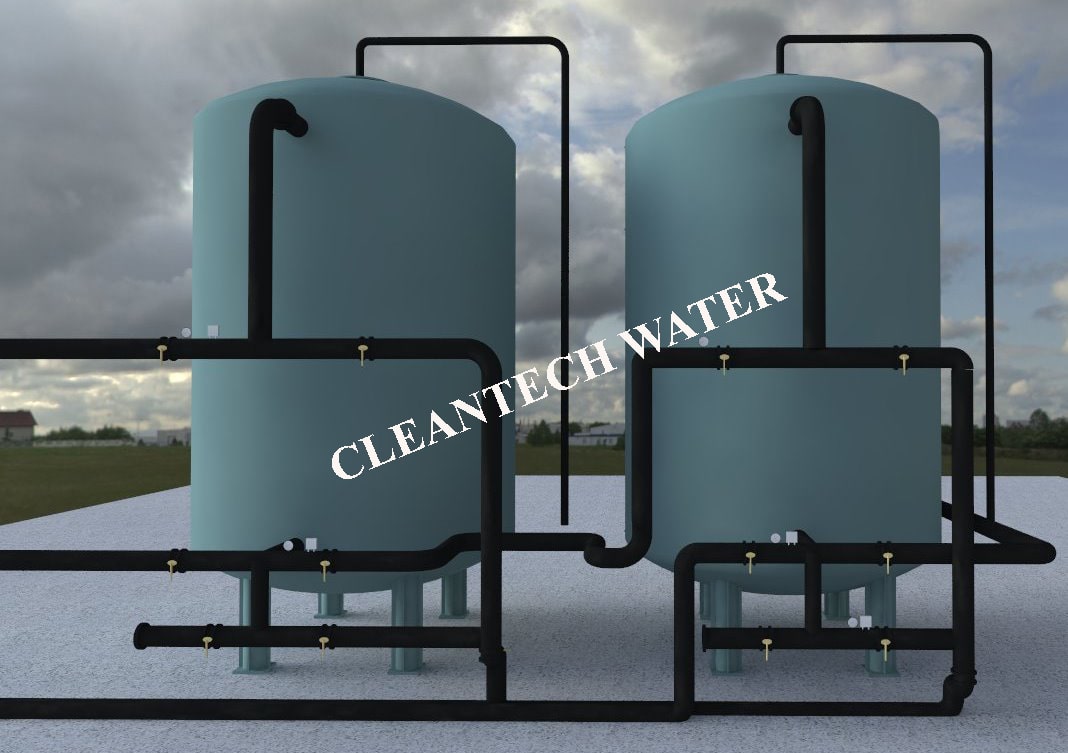
How Does an Activated Carbon Filter Work? The Complete Working Principle
The working principle of an activated carbon filter is adsorption — a physical-chemical process in which dissolved contaminant molecules in water are attracted to and held on the surface of carbon particles. This is different from absorption (where a substance is taken in throughout a material); in adsorption, the contaminant attaches to the outer and inner pore surfaces of the carbon.
Here is how the process works, step by step:
- Influent water enters the filter vessel through the inlet at the top
- Water flows downward through a bed of activated carbon media (granular, block, or powdered)
- Contaminant molecules — chlorine, VOCs, organic compounds, taste and odour compounds — come into contact with the porous carbon surface
- Van der Waals forces (weak molecular attraction forces) pull and hold contaminant molecules onto the carbon surface
- Treated water exits through the outlet at the bottom, significantly reduced in dissolved organics, chlorine, and colour
- Backwashing periodically releases accumulated solids and extends media life
The effectiveness of this working principle depends on three critical parameters:
- Empty Bed Contact Time (EBCT): The time water spends in contact with the carbon bed. Standard industrial applications require 10–20 minutes EBCT for effective organic removal.
- Surface area: Activated carbon has a surface area of 500–1,500 m² per gram — a teaspoon of activated carbon has more internal surface area than a football field.
- Carbon bed depth: Deeper beds allow longer contact time and better removal efficiency.
Need an ACF System Sized for Your Flow Rate & Water Quality?
What Is Activated Carbon? How Is It Made?
Activated carbon is a specially processed form of carbon with an extremely high surface area and porous structure, created through a two-stage manufacturing process:
Stage 1 — Carbonisation
Raw carbonaceous material (coconut shell, coal, wood, or bamboo) is heated to 600–900°C in an oxygen-free environment. This removes non-carbon elements (hydrogen, oxygen, nitrogen) and produces a char with a basic porous structure.
Stage 2 — Activation
The char is exposed to steam, carbon dioxide, or chemical activating agents at high temperatures (800–1,000°C for steam activation; 450–900°C for chemical activation). This process dramatically increases the pore network, creating the massive internal surface area that makes activated carbon effective at trapping contaminants.
Coconut shell-based activated carbon is generally preferred for water treatment applications in India because it produces a harder, denser carbon with a predominantly microporous structure — ideal for removing small organic molecules and chlorine compounds. According to BIS standards for water treatment media, coconut shell-based activated carbon offers superior hardness and lower ash content compared to coal-based alternatives.
Types of Activated Carbon Used in Water Treatment
Choosing the correct form of activated carbon is as important as the filter design itself. There are four main types used in industrial and commercial water treatment:
| Type | Form | Best For | Typical Application |
|---|---|---|---|
| Granular Activated Carbon (GAC) | Irregular granules, 0.5–2.5 mm | Organic removal, chlorine, taste & odour | Municipal plants, industrial pre-treatment |
| Powdered Activated Carbon (PAC) | Fine powder, <0.075 mm | Rapid adsorption, emergency dosing | Seasonal contamination, batch treatment |
| Carbon Block | Compressed solid block | Drinking water, sediment + carbon combined | Point-of-use, residential RO systems |
| Catalytic Carbon | Modified GAC | Chloramines, hydrogen sulfide removal | Swimming pools, advanced municipal treatment |
Granular Activated Carbon (GAC)
GAC is the most widely used form in industrial water treatment plants across India. Its irregular grain structure creates natural channels for water flow while providing sufficient surface area for adsorption. GAC systems are designed as fixed-bed columns through which water flows continuously. They are regenerable — exhausted GAC can be thermally reactivated, making large-scale installations economically viable over multiple cycles. To understand how GAC compares with PAC across different treatment applications, read our detailed guide on granular vs powdered activated carbon for ETP and STP. For industrial applications, Cleantech Water recommends GAC with iodine numbers above 900 mg/g, in compliance with IS 877 standards for water treatment grade activated carbon.
Powdered Activated Carbon (PAC)
PAC is dosed directly into water as a slurry and removed by coagulation, flocculation, and sedimentation. Because of its fine particle size and very high surface area-to-volume ratio, PAC achieves rapid adsorption kinetics — making it ideal for emergency treatment of taste and odour events or seasonal contamination spikes. It is not regenerable and is used on a single-pass basis.
Activated Carbon Block
Carbon block filters combine activated carbon with a binder compressed at high pressure into a solid block. The controlled pore structure provides both mechanical filtration (typically 0.5–5 microns) and adsorption, making carbon block ideal for point-of-use drinking water systems. For a detailed comparison of carbon block and charcoal-based filter media, see our guide on charcoal filters vs activated carbon filters. Carbon block filters are the standard pre-treatment cartridge in residential and commercial RO water purifiers across India.
Catalytic Carbon
Standard activated carbon removes chlorine effectively but struggles with chloramines — the disinfection by-product formed when chlorine combines with ammonia in municipal water supplies. Catalytic carbon incorporates catalytic surface groups that break down chloramine molecules chemically, converting them to harmless nitrogen and chloride. For facilities in areas where the municipal supply uses chloramination, catalytic carbon is the specified media.
How Do Activated Carbon Filters Work in Industrial Water Treatment?
In industrial water treatment plants — whether for boiler feed water, pharmaceutical process water, or food and beverage production — activated carbon filters typically serve as the second stage after multimedia/sand filtration and before membranes (RO or UF) or ion exchange systems.
Standard industrial ACF process flow:
Raw Water → Coagulation / Flocculation → Pressure Sand Filter → Activated Carbon Filter → RO / UF → Product Water
The ACF stage in this sequence has two primary functions:
- Dechlorination: Removing residual chlorine before the RO membrane — even 0.1 ppm residual chlorine causes irreversible damage to polyamide RO membranes
- Organic reduction: Reducing TOC (Total Organic Carbon) to protect downstream ion exchange resins and meet process water quality specifications
For industrial effluent treatment (ETP) applications, activated carbon filters are used in the tertiary treatment stage to remove colour, COD load, and residual organics from secondary-treated effluent before discharge or reuse. CPCB guidelines specify maximum COD and colour values that activated carbon polishing can help achieve.
What Does an Activated Carbon Filter Remove from Water?
Activated carbon filters are highly effective at removing a specific range of contaminants. For a comprehensive breakdown, see our dedicated page on what activated carbon filters remove from water. Understanding what they do and do not remove helps set correct expectations for system design.
✅ Effectively removed by activated carbon filters:
- Free chlorine and chloramines (with catalytic carbon)
- Volatile organic compounds (VOCs) — benzene, toluene, xylene, chloroform
- Pesticides and herbicides
- Trihalomethanes (THMs) — disinfection by-products
- Taste and odour compounds — hydrogen sulphide, geosmin, 2-MIB
- Colour (from humic and fulvic acids)
- Phenols and industrial solvents
- Certain heavy metals — lead, mercury (to a limited extent)
❌ NOT effectively removed by standard activated carbon filters:
- Dissolved inorganic salts (TDS, hardness, sodium, fluoride)
- Nitrates and nitrites
- Bacteria and viruses (carbon can harbour biofilm without antimicrobial treatment)
- Heavy metals at high concentrations
- Arsenic (requires specialised media)
This is why activated carbon filters in industrial plants are always paired with appropriate pre-treatment and post-treatment stages. A standalone ACF is one critical component in a properly engineered treatment train — not a complete water purification solution on its own.
Activated Carbon Filter vs. Other Filtration Technologies
Comparing activated carbon filtration with other technologies helps clarify where each fits in a treatment system. For a focused comparison between the two most commonly paired technologies, read our guide on how sand filters differ from activated carbon filters. The table below gives a broader overview:
| Parameter | Activated Carbon Filter | Sand Filter | RO Membrane | UV Steriliser |
|---|---|---|---|---|
| Removes organics / chlorine | ✅ Excellent | ❌ No | ✅ Good | ❌ No |
| Removes dissolved salts (TDS) | ❌ No | ❌ No | ✅ Excellent | ❌ No |
| Removes bacteria / viruses | ❌ No | ❌ Partially | ✅ Good | ✅ Excellent |
| Removes suspended solids | Partially | ✅ Good | ✅ Excellent | ❌ No |
| Media regeneration possible | ✅ Yes (GAC) | ✅ Backwash | ❌ Replace | — Lamp only |
| Typical media lifespan | 2–5 years | 5–10 years | 3–7 years | 1 year (lamp) |
How to Choose the Right Activated Carbon Filter for Your Application
Selecting the correct ACF system involves evaluating six key parameters:
- Identify your target contaminants: The contaminants in your source water determine both carbon type and system configuration. Chlorine removal uses standard GAC; chloramine removal requires catalytic carbon; colour removal for ETP needs specific iodine number and contact time calculations.
- Specify your flow rate and bed volume: ACF systems are sized by the relationship between flow rate (m³/hour) and bed volume (m³ of carbon). The hydraulic loading rate must stay within 5–20 m/hour for effective contact. Undersizing reduces treatment; oversizing increases capital cost.
- Evaluate inlet water quality: High suspended solids will blind the carbon bed, reducing adsorption life. If inlet TSS exceeds 5–10 ppm, a sand or multimedia filter must precede the ACF. High iron or manganese must also be pre-treated.
- Determine regeneration requirements: Large-scale systems (beds over 2,000 kg of carbon) should incorporate provisions for thermal regeneration to manage lifecycle costs. Smaller systems use replaceable carbon charges.
- Select vessel construction material: For industrial applications, ACF vessels are typically MS with FRP lining, FRP, or SS 304/316 depending on water chemistry (pH, chloride content, temperature). For corrosive industrial effluents, FRP vessels are standard.
- Compliance requirements: Municipal ACF systems must comply with BIS IS 10500 (drinking water standards) and relevant state PCB guidelines. Industrial ETP discharge must meet CPCB general effluent standards.
Activated Carbon Filter Maintenance: What to Expect
Proper maintenance is essential to sustain ACF performance. A neglected carbon bed can become a contamination source rather than a treatment stage.
| Maintenance Task | Frequency | Purpose |
|---|---|---|
| Backwashing | 2–3 times per week | Removes accumulated solids, prevents channelling |
| Pressure differential check | Daily | Identifies bed fouling or excessive solids loading |
| Residual chlorine check (outlet) | Daily | Confirms carbon bed is still active (dechlorination duty) |
| Carbon bed sampling (iodine number test) | Every 6 months | Lab analysis to assess remaining adsorption capacity |
| Carbon replacement or regeneration | Every 2–5 years | Restores full adsorption capacity |
| Vessel inspection | Annual | Checks corrosion, liner integrity, distributor condition |
Warning signs that your ACF requires immediate attention:
- Residual chlorine detected at the outlet (on dechlorination duty)
- Colour or odour breakthrough in treated water
- Pressure differential across the bed exceeding design limits
- Microbiological contamination in treated water (indicates biofilm growth in the bed)
Frequently Asked Questions About Activated Carbon Filters
What is the working principle of an activated carbon filter?
The working principle of an activated carbon filter is adsorption. When water flows through the filter, dissolved contaminants — including chlorine, organic compounds, VOCs, and taste and odour-causing substances — are attracted to and held on the highly porous surface of the carbon particles. Activated carbon has a surface area of 500–1,500 m² per gram, providing enormous contact area for this process. The carbon physically holds contaminants on its surface until exhausted and requiring replacement or regeneration.
How often should activated carbon filter media be replaced in a water treatment plant?
Replacement frequency depends on the volume of water treated, contaminant concentration, and carbon bed volume. For municipal and industrial dechlorination duty, GAC beds typically last 2–5 years. Performance monitoring — specifically iodine number testing every 6 months and daily residual chlorine monitoring at the outlet — is the most reliable indicator of when replacement is needed. Cleantech Water provides scheduled carbon bed management services including sampling and replacement programmes.
Can an activated carbon filter remove bacteria and viruses from water?
No. Activated carbon filters are designed to remove dissolved organic contaminants through adsorption and are not effective at removing bacteria or viruses. Wet carbon beds can even support bacterial biofilm growth if not properly maintained. For microbial disinfection, ACF must be combined with UV sterilisation, ozonation, or residual chlorination. In a properly designed treatment plant, the ACF stage precedes the disinfection stage.
What is the difference between GAC and carbon block filters?
Granular Activated Carbon (GAC) consists of loose carbon granules packed into a vessel for large-scale industrial and municipal systems — it is regenerable and has a service life of 2–5 years. Carbon block filters compress activated carbon into a solid block for point-of-use applications like residential RO systems, replaced as cartridges every 6–12 months. For industrial water treatment plants, GAC systems are the standard specification.
Can activated carbon filters handle industrial effluent treatment?
Yes. Activated carbon filters are widely used in the tertiary stage of Effluent Treatment Plants (ETPs) across pharmaceutical, textile, food processing, and chemical manufacturing industries to reduce colour, COD, and residual organics in secondary-treated effluent before discharge or reuse. System design parameters — bed volume, EBCT, hydraulic loading rate — must be calculated based on the specific effluent characteristics.
What is ACF full form in water treatment?
ACF stands for Activated Carbon Filter in water treatment terminology. In plant design documents and process flow diagrams (PFDs), ACF denotes the activated carbon filter stage in the treatment train — typically positioned after the multimedia/sand filter (MMF) and before the reverse osmosis (RO) unit. It is also written as AC Filter or carbon filter in some documentation.
Contact Us for Activated Carbon Filter Installation and Maintenance
Activated carbon filters remain one of the most versatile and cost-effective technologies in water treatment — but their performance is entirely dependent on correct design, appropriate carbon selection, and disciplined maintenance. A properly engineered ACF system removes chlorine, organics, VOCs, and colour with high efficiency, protects downstream membranes and ion exchange systems, and helps facilities meet BIS and CPCB compliance standards.
Whether you need a dechlorination filter for RO pre-treatment, an ETP polishing system for effluent colour removal, or a complete integrated water treatment plant, Cleantech Water’s engineering team can design, supply, and commission the right activated carbon filter system for your facility.
Contact Cleantech Water today for professional installation and maintenance services. Our team of experts will ensure seamless integration of activated carbon filters into your existing setup or new construction project. Whether you need granular activated carbon (GAC), powdered activated carbon (PAC), or specialised catalytic carbon solutions, we have the expertise to meet your specific water treatment needs.
Reach out to us now at +91-9558996411 or email us at info@cleantechwater.co.in to schedule a consultation. Take the first step towards cleaner, safer water for your home or business.